

More Than Length: How Salons Can Combine Hair Toppers with Extensions
For many clients, adding length is only part of the transformation. A client may want longer, fuller hair while also experiencing thinning around the crown or parting. Extensions can add length and volume, but they do not address upper coverage in the same way a hair topper does.
Salons can combine a hair topper with extensions when a client needs both: coverage through the top and additional length or fullness through the mid-lengths and ends. The topper addresses the upper area, while the extensions add length to the lower sections. The key is to plan the area to cover, where to attach, density, color, texture, and final cut as one service.
Using two real salon combinations, this Newtimes Hair guide explains how professionals can assess client suitability, select compatible products, and create a natural-looking result.
When Should a Salon Combine a Topper with Extensions?
Combining a hair topper with extensions works best when the client has two distinct needs: coverage through the top and additional length or fullness through the lower sections.
For example, a client may have visible thinning around the crown or parting while still wanting longer, denser hair through the mid-lengths and ends. In this situation, extensions alone may leave the top looking comparatively flat, while a topper alone may not deliver the overall transformation the client wants.
| Client Concern | Possible Solution |
| Crown, parting, or top appears thin | Hair topper |
| Hair lacks length or fullness through the mid-lengths and ends | Hair extensions |
| Both concerns are present | Hair topper + extensions |
| Mainly needs focused parting coverage | Lace closure + extensions may also be considered |
Not every client needs both.
If crown density is already sufficient, extensions may be enough. If the client only needs additional top coverage and is happy with the existing length, a topper may be the simpler solution.
Before recommending a combined service, assess the client’s natural hair strength, scalp condition, available attachment areas, lifestyle, and ability to follow the maintenance plan.
Start With the Top: Choosing the Right Coverage
The topper should be applied around the client’s actual thinning area rather than simply selecting the highest density available.
When extensions are used together with the topper, the top usually needs to blend into the finished style rather than overpower it.
At Newtimes Hair, different topper constructions allow salons to approach different coverage needs.
| Coverage need | Product option | Why it may fit |
| Localized or early-stage thinning | SIDNEY | Its compact coverage suits clients who do not need an extensive crown area. |
| Broader, lightweight coverage | ELOISE | It provides broader coverage while keeping the finished result soft and natural. |
| More coverage with a realistic scalp appearance | ORPHA | Its silk-top construction creates a natural-looking crown finish. |
| A more integrated, salon-managed service | TEENA | Its mesh integration construction allows the stylist to plan coverage around the client’s natural hair and service plan. |
| Parting-focused coverage | Lace closure | It can provide targeted parting coverage when a wider topper is unnecessary. |
The key is that the product should follow the client’s needs—not the other way around.
Then Choose the Extension Method
Once the coverage area is established, the stylist can decide how much additional length and volume is needed through the lower sections.
For more substantial length and overall fullness, Genius Weft extensions offer stylists flexibility in creating a fuller finished shape while keeping the weft construction light and easy to blend.
For more targeted placement, Injected Tape-in extensions allow the stylist to distribute volume and length around the natural hair according to the finished style.
Plan the topper and extension attachment zones together. Do not place topper clips, integration areas, or other attachment points directly over extension connections. Overlapping these areas can create unnecessary tension and make maintenance more difficult.
Salon rule: Plan the coverage area first, then build the extension placement around it.
Natural Blending Goes Beyond Color
A seamless result depends on more than matching a shade number.
The topper must blend with the client’s roots and crown, while the extensions need to transition naturally through the mid-lengths and ends.
Stylists should also compare:
- hair texture and strand thickness
- shine level
- density
- movement after washing
- finished length
- the amount of cutting and layering required
A topper that is much denser or heavier than the client’s natural hair can make the crown look disconnected from the extensions below. Likewise, two products may appear to match when new but behave differently after washing and styling.
A natural blend depends on matching the root color, creating a smooth length transition, choosing compatible textures, balancing density, and finishing with professional cutting and layering.
Real Salon Combination Case 1: ORPHA + Injected Tape-in
The following examples show real salon applications using Newtimes Hair products. Product selection and results may vary depending on the client’s natural hair, coverage needs, available attachment areas, and service plan.
Premium Crown Coverage + Seamless Length
For clients who want a natural-looking scalp appearance together with additional length and movement, ORPHA + Injected Tape-in extensions can create a complete transformation.
ORPHA provides crown coverage, while Injected Tape-in adds length and fullness through the lower sections.
Injected Tape-in extensions can then be placed through the lower sections to build length and volume without competing with the topper attachment area.
Together, the two products address different parts of the hairstyle:
ORPHA restores the top. Injected Tape-in builds the lengths.
For the salon, the result is a transformation that feels balanced rather than simply “more voluminous.”
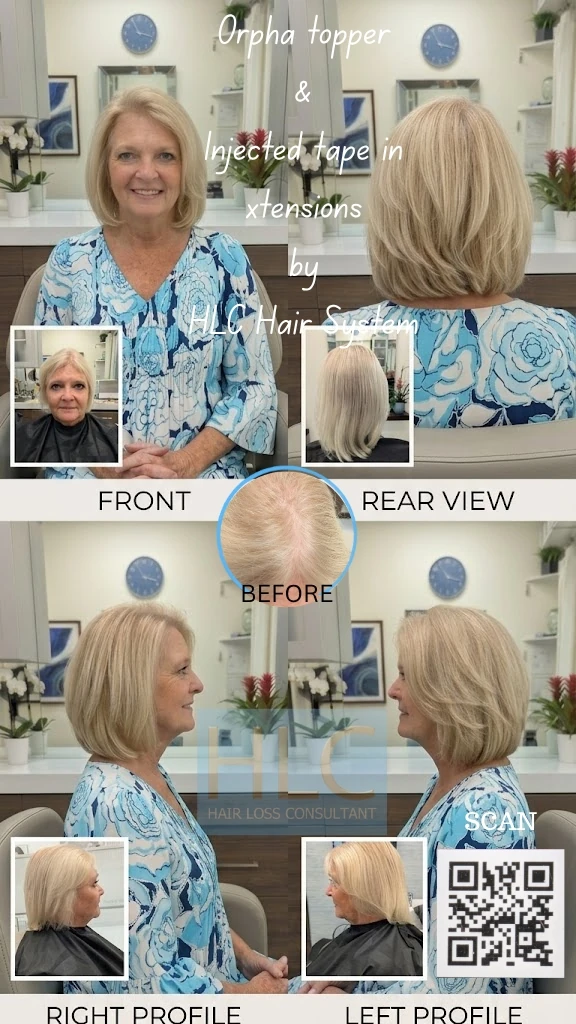
ORPHA + Injected Tape-in before-and-after real salon result: ORPHA silk-top hair topper paired with Injected Tape-in extensions for crown coverage and added length after image
Real Salon Combination 2: Lace Closure + Genius Weft
Natural Parting + Fuller Lengths
Not every client requires a full topper.
When the main concern is creating more natural-looking coverage around the parting while also adding significant length and fullness, a Lace Closure + Genius Weft combination can be an effective alternative.
The lace closure creates the upper coverage and parting area, while Genius Weft builds volume, movement, and length through the rest of the hairstyle.
This allows the stylist to create a fuller transformation without adding unnecessary coverage where the client does not need it.
Real-Life Showcase: Toppers & Extensions Together
(A special thank you to @hair.lab.uk for sharing this incredible video feedback with us! We love seeing our hair extensions and toppers brought to life by such talented professionals. Be sure to check out their page for more amazing work!)
One Client, One Combination
There is no single topper-and-extensions formula that works for every client.
Start with the client’s coverage needs. Then select the extension method around the natural hair, desired volume, available attachment areas, and maintenance preferences.
That is where the value of this service really lies: not in selling two products instead of one, but in giving the stylist more ways to solve the client’s actual hair concerns.
More Possibilities for the Salon
Combining hair toppers with extensions gives salons a way to address crown coverage, density, length, movement, and overall shape within one planned service. It can also support clients whose needs may not be fully addressed by extensions alone.
At Newtimes Hair, professional toppers including SIDNEY, ELOISE, ORPHA, and TEENA can be paired with Genius Weft and Injected Tape-in extensions according to the client’s hair condition, attachment areas, desired result, and maintenance plan.
The best combination starts with one question:
What does this client actually need the finished hair to do?
Build the Right Combination for Your Clients
Every client starts with a different hair condition, and the right combination should reflect that.
Explore Newtimes Hair professional toppers and extensions, or ask our team for help comparing coverage, construction, and attachment options for your salon services.
Request Product Recommendations →