



Simplify Wholesale Hair Selection: The Professional Buyer’s Guide to Men’s Hair Systems, Women’s Wigs & Toppers, and Custom Items
For professional hair buyers, the hard part is rarely finding a product. It is finding the right information quickly enough to make a confident choice.
A hair replacement center may need to compare base construction, hairline design, density, color, and attachment requirements for men’s systems. A wig store may be comparing coverage, cap construction, hair type, color, length, and ease of wear for women’s products. The decision process is different—and treating it as one long product list can make it harder than it needs to be.
That is why Newtimes Hair has separated its selection information into two dedicated paths on the Hair System Selection Hub: a Men’s Hair System Guide and a Women’s Wigs & Toppers Guide. Instead of making professional buyers work through specifications that may not apply to their business or client, the two sections let them go directly to the information relevant to the product category they are sourcing.
This guide shows how to use that structure in practice—and how separating the two selection paths can make product decisions more organized.
1. Men’s Hair Systems: Start With the Specification You Actually Need
For hair replacement centers and professional hair replacement studios, product selection often starts with a client consultation. The goal is not to memorize every model. It is to identify the few specifications that will affect the recommendation.
For example, a client may care most about the appearance of an exposed front hairline, while another may place more emphasis on breathability, durability, density, or maintenance. Once that priority is clear, you can go directly to the relevant selection topic instead of comparing every system from scratch.
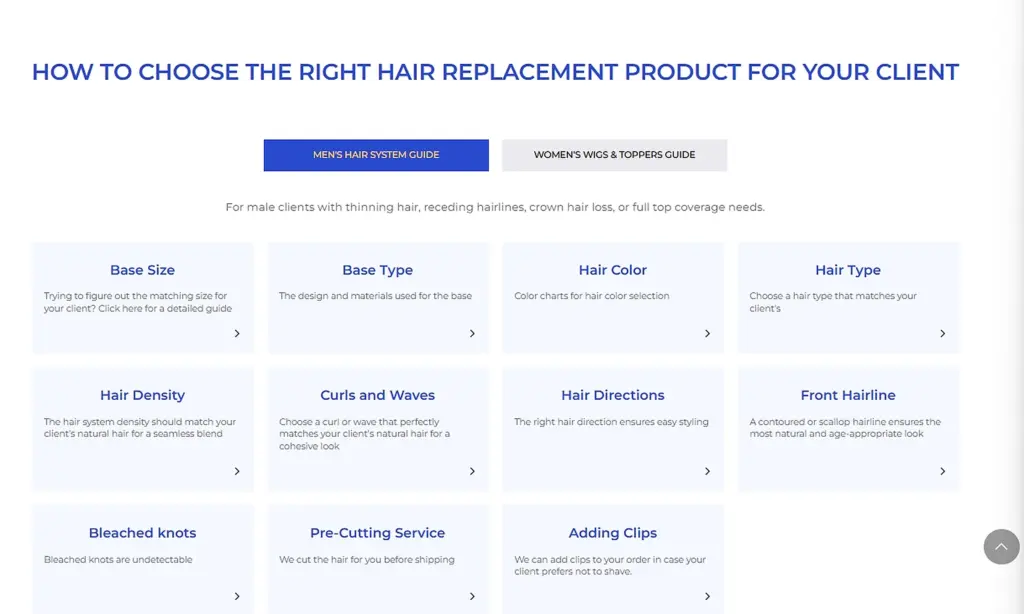
Newtimes Hair’s Men’s Hair System Guide brings the main selection and service topics together in one place, including:
- Base Size and Base Type
- Hair Color and Hair Type
- Hair Density and Curls & Waves
- Hair Directions
- Front Hairline and Bleached Knots
- Pre-Cutting Service and Adding Clips
Explore these specifications in the Men’s Hair System Selection Guide.
Use the guide to narrow the choice—not to replace your professional judgment
The selection page is most useful when you already know what you are trying to solve. If a client wants a very natural-looking exposed hairline, for example, you can review the Front Hairline topic and compare relevant construction options. If the client’s hairstyle depends on a particular direction, you can go directly to Hair Directions. If the main question is whether a stock base can be prepared before shipment, Pre-Cutting Service gives you a separate place to check that option.
This approach is also useful for repeat clients. You may already know most of the client’s requirements and only need to verify one or two specifications before reordering. The guide lets you check those details without turning every reorder into a complete product-selection exercise.
A few examples of how the specifications connect
Newtimes Hair’s current product information illustrates why the specifications should be considered together:
- HS25V is a 0.03 mm V-looped ultra-thin skin system. Newtimes Hair positions 0.03 mm skin around maximum naturalness and an ultra-thin, close-to-the-scalp finish; its practical lifespan is about 3–4 weeks, although actual lifespan varies with use and maintenance.
- HS1V is a 0.06 mm V-looped super-thin skin system. Newtimes Hair describes 0.06 mm as a balance between naturalness and regular wear, with a commonly used planning range of 2–3 months.
- HS1 is a 0.08 mm knotted thin-skin system with a 1/2-inch V-looped front hairline and single split knots across the rest of the base. The thicker skin and knotted construction place more emphasis on support and durability than the thinnest V-looped skin options.
- HS7 is a full French lace system. Newtimes Hair positions French lace around airflow, comfort, and active or warm-climate use.
- HOLLYWOOD combines French lace with a thin clear PU perimeter and a 1/2-inch French lace front, providing a hybrid option for professional buyers who want to balance breathability with attachment and maintenance considerations.
- HS27P uses a fine mono base with a skin-gauze perimeter and French lace front, providing another option when structure and durability are important.
For a deeper explanation of how skin thickness changes the trade-offs, see 0.03 vs. 0.06 vs. 0.08 mm Skin Hair Systems.
For a broader comparison of skin, lace, mono, and hybrid constructions, see How to Choose Between Skin, Lace, Mono, and Hybrid Hair-System Bases.
The point is not that one construction is universally better. The point is that the guide lets you connect the client’s priority to the specification that matters most, then use the product pages to confirm the exact model.
2. Women’s Wigs & Toppers: Start With Coverage, Then Compare the Details
Women’s hair replacement has a wider range of product categories, so the first decision is often not a base material. It is the type of solution the client needs.
That is one reason separating women’s selection information from men’s selection information is useful. A professional sourcing women’s products may be deciding between a topper, a women’s hair replacement system, a hair integration system, or a full wig. Those categories address different coverage and wearing situations, so beginning with the correct category can remove a large part of the search before you compare individual specifications.
Step 1: Identify the coverage and product category
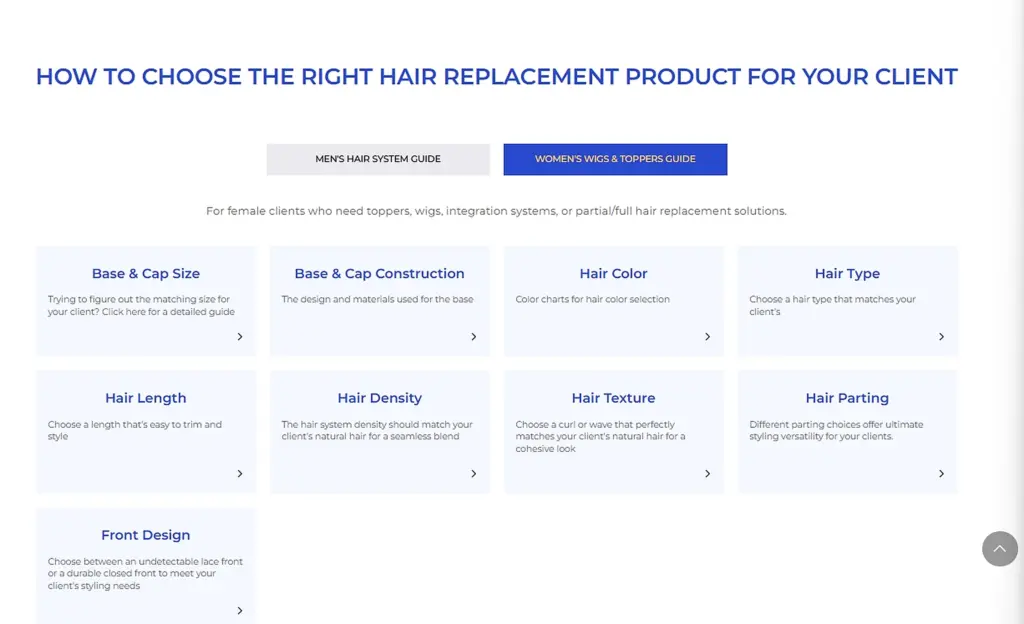
Newtimes Hair currently organizes women’s products into several categories, including Human Hair Wigs, Human Hair Toppers, Hair Integration Systems, Women’s Hair Replacement Systems, and Medical Grade Wigs.
- Toppers are relevant when the client needs coverage over a thinning area while blending with the remaining natural hair. The current women’s hair system guidance specifically discusses thinning crown, thinning top, and throughout-top coverage.
- Hair integration systems are designed to blend with the client’s remaining natural hair. Newtimes Hair explains that sufficient natural hair is needed for the mesh integration approach, which allows the client’s own hair to be pulled through the mesh.
- Women’s hair replacement systems provide another category for clients experiencing different stages or patterns of hair loss; the current collection includes options with different coverage, hair lengths, densities, and base designs.
- Full wigs provide broader coverage and are a separate product category from toppers and integration systems. Newtimes Hair’s current wig collection includes lace front, hand-tied, glueless, medical-grade, and other styles.
Browse the current Women’s Hair Replacement Systems collection.
For broader wig options, see Wholesale Human Hair Wigs.
For mesh-based solutions, see Hair Integration Systems.
Step 2: Once the category is clear, compare the specifications that affect the client’s result
After deciding whether the client needs a topper, integration system, women’s hair replacement system, or wig, the next comparison becomes much more practical.
- Coverage and base size: Make sure the selected piece provides the coverage required and fits the client’s needs.
- Base material and construction: Compare the actual base used by the specific product rather than assuming every women’s piece uses the same construction.
- Hair type and texture: Match the hair characteristics to the client’s natural hair and the intended result.
- Color: Compare the product with the client’s natural hair. Newtimes Hair recommends using a color chart, color ring, or hair sample rather than relying only on a monitor.
- Density and length: Confirm the specifications of the exact product because available values vary by style.
- Attachment and wear: Check how the specific product is designed to be worn. Toppers are commonly attached with clips, while attachment options for other women’s systems vary by product.
For color matching, use the Newtimes Hair Color Charts available through the selection hub, and consider a physical color ring or hair sample when accuracy matters.
This is where the women’s guide can save time. Instead of starting with a long list of individual wigs and toppers, a buyer can first identify the appropriate product category and coverage requirement, then check the specifications that matter for that category.
Step 3: Match the product to your business model
The product decision also affects the amount of service your business needs to provide.
A wig retailer may prioritize ready-to-wear human hair wigs, with style, color, length, cap construction, and ease of wear playing a larger role in the buying decision. A hair replacement center may need to consider additional work such as trimming, blending, color adjustment, styling, or installation, depending on the product and the client’s requirements.
This does not mean one business model should only buy one type of product. It means the same product specification can have a different operational impact depending on how you plan to sell or service it.
For example, a clip-in topper and a system that requires a different attachment method should not be evaluated only by appearance. The time, skill, and service involved in preparing the product for the client can also affect whether it is a good fit for your business.
Explore these specifications in the Women’s Hair System Selection Guide.
3. From Product Selection to Your Next Wholesale Order
Once you have narrowed the product category and specifications, the next step is to confirm what can actually be ordered.
Stock products vs. custom requests
Newtimes Hair distinguishes between stock and custom hair replacement products. Stock products are premade, off-the-shelf products that are ready to ship upon purchase. Custom products are made to order for requirements that call for customization.
That distinction matters for purchasing decisions. If a suitable stock product already matches the client’s requirements, you can start from an existing specification. If the standard options do not fit the requirement, a custom request can be considered instead.
See the Custom Order Form when you need to discuss a non-standard requirement.
For either route, confirm the exact product specifications, availability, customization requirements, and applicable delivery timing before making a promise to your client.
Check available add-on services before you place the order
Newtimes Hair currently offers add-on services such as hair cutting and base cutting, and clips can be added when requested. Whether an option applies depends on the product and order requirements, so it is better to confirm it at the time of ordering.
Review Pre-Cutting Service before ordering if you want the hair or base prepared in advance.
For clip attachment, see Adding Clips in the selection hub.
A simpler wholesale ordering checklist
- Identify the client’s coverage requirement and the product category.
- Confirm the base construction and other specifications relevant to the chosen product.
- Verify color with a physical color reference or hair sample when possible.
- Confirm hair type, length, density, curl or wave, and direction where applicable.
- Check the exact SKU, stock status, customization options, add-on services, and delivery estimate before placing the order.
When the specifications are clear, use Newtimes Hair’s How to Order guidance to move from product selection to ordering.
The goal is simpler selection, not more information
Professional buyers do not necessarily need a longer product list. They need the right information at the right point in the decision.
That is the logic behind separating the Men’s Hair System Guide from the Women’s Wigs & Toppers Guide. A hair replacement specialist can focus on the specifications that matter to men’s systems. A buyer sourcing women’s products can first identify the right category and coverage, then compare the relevant base, hair, color, density, length, and attachment details.
Instead of searching through every product to find one answer, you can start with the client’s need, open the relevant selection path, confirm the specification, and then move to the product or ordering stage.
Explore both paths on the Newtimes Hair Hair System Selection Hub.
About the Author

Alf Hou is a Hair Replacement Specialist and Technical Consultant at Newtimes Hair, with industry experience since 2018. He specializes in men’s hair systems, women’s wigs and toppers, and custom hair replacement solutions. Through his articles, Alf shares practical insights into hair system construction, product selection, and maintenance to help hair replacement professionals make informed decisions for their businesses and clients. Connect with Alf on LinkedIn.
Frequently Asked Questions
See the available Color Charts and Selection Tools on the selection hub.