




0.03 vs. 0.06 vs. 0.08 mm Skin Hair Systems: A Professional Comparison
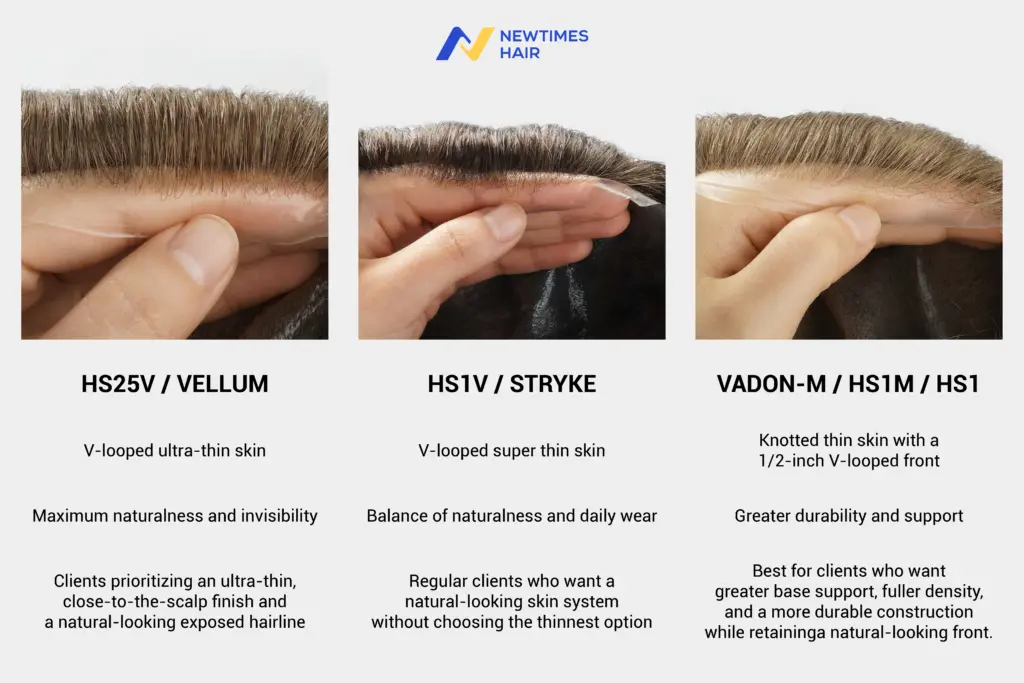
In general, 0.03 mm prioritizes maximum naturalness, 0.06 mm offers the most practical balance for regular wear, and 0.08 mm provides greater support for fuller styles and longer service life. The correct choice also depends on ventilation method, density, hair length, attachment routine, and client expectations.
For hair replacement studios, thickness should be treated as one part of a complete specification—not as a standalone quality ranking. Ventilation construction, hairline design, density and hair-length requirements, maintenance expectations, and the client’s priorities should also be considered before choosing a skin hair system.
At-a-Glance Comparison
| Skin thickness | NEWTIMES HAIR example | Construction | Main priority | Best suited to |
| 0.03 mm | HS25V / VELLUM | V-looped ultra-thin skin | Maximum naturalness and invisibility | Clients prioritizing an ultra-thin, close-to-the-scalp finish and a natural-looking exposed hairline |
| 0.06 mm | HS1V / STRYKE | V-looped super thin skin | Balance of naturalness and daily wear | Regular clients who want a natural-looking skin system without choosing the thinnest option |
| 0.08 mm | VADON-M / HS1M / HS1 | Knotted thin skin with a 1/2-inch V-looped front | Greater durability and support | Best for clients who want greater base support, fuller density, and a more durable construction while retaining a natural-looking front. |
Key Takeaways
- 0.03 mm ultra-thin skin systems prioritize maximum naturalness and invisibility.
- 0.06 mm thin skin systems provide a practical middle ground between a natural appearance and regular daily wear.
- 0.08 mm skin systems prioritize stronger support and durability and are better suited to longer wear or fuller styles.
- Base thickness is not the same as hair density. Construction, hair length, density, hairline design, and maintenance expectations also matter.
How Do We Create the Poly Skin Base?
The material used for a skin base is polyurethane (PU). Base thickness is controlled by how polyurethane is applied to the mold: generally, a thicker base requires more layers of poly.
During production, a thickness gauge is used to check the base and verify that the material meets the target specification. For a meaningful quality check, thickness should be measured at multiple points across the base rather than at only one spot.
For quality control, thickness should be checked at multiple points across the base, including central and perimeter areas. A single measurement may not represent the thickness of the complete system.
For a broader comparison of lace, skin and mono constructions, see our guide to hair system base types.

How Does Each Thickness Work?
Skin hair systems are produced in different thicknesses to serve different client priorities. The goal is not to recommend the thinnest option automatically, but to match the base to the client’s expectations for appearance, wear, support, and maintenance.

(Note: The measurements shown are production specifications. Actual performance also depends on base size, ventilation, density, hair length, and maintenance.)
1. 0.03 mm Skin Hair Systems: Maximum Naturalness and Invisibility
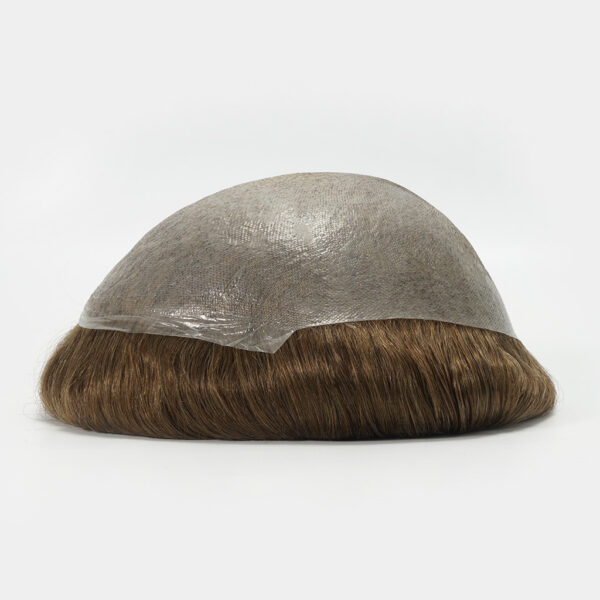
NEWTIMES HAIR’s HS25V uses a 0.03 mm V-looped ultra-thin skin base. VELLUM is designed for clients who want a very light, “barely-there” effect, particularly when a natural-looking front hairline is exposed, or a highly realistic finish is the top priority.
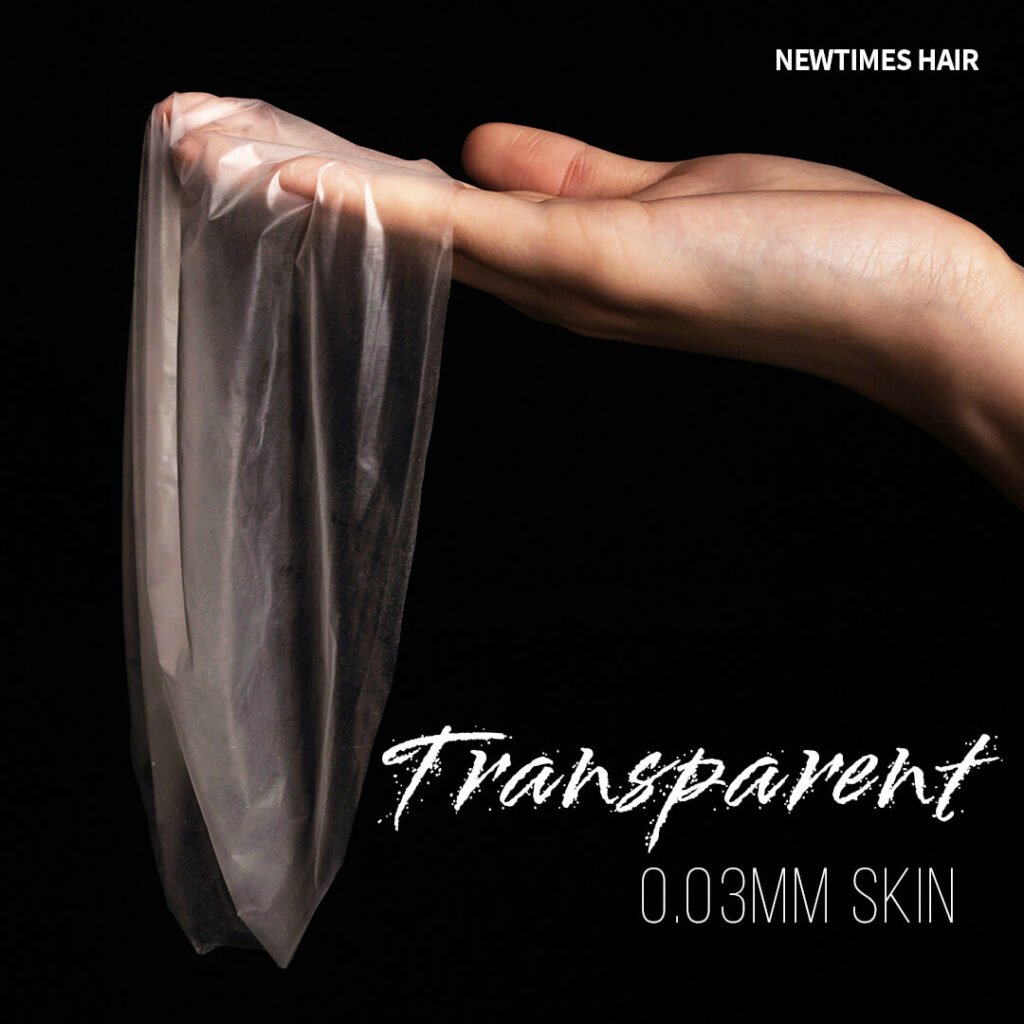
The trade-off is durability. Many 0.03 mm skin systems are intended for short-term wear and have a practical planning lifespan of about 3–4 weeks. Actual lifespan varies with ventilation, density, hair length, attachment method, scalp condition, maintenance, and handling. These systems are generally less suitable for very long, heavy or high-density styles.
NEWTIMES HAIR’s VELLUM HS25V is one example of a 0.03 mm V-looped ultra-thin skin system for clients who prioritize a thin, close-to-the-scalp appearance.
(Click the product to view more details)
2. 0.06 mm Skin Hair Systems: A Balance for Everyday Wear
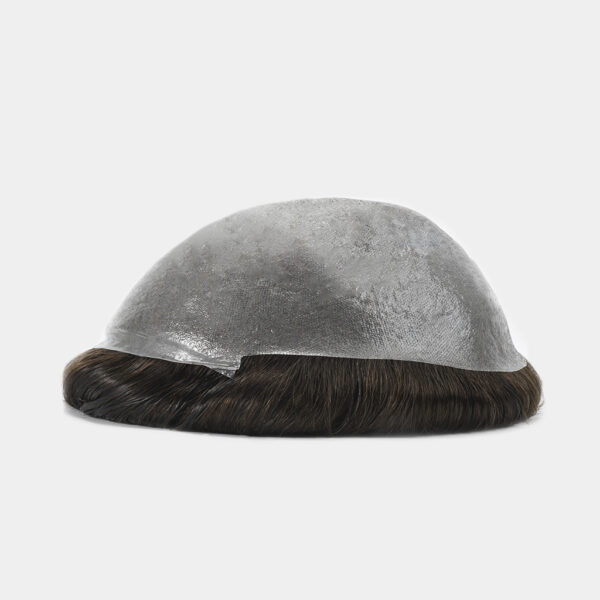
STRYKE / HS1V is specified by NEWTIMES HAIR as a 0.06 mm V-looped super-thin skin system with 100% density and a 5-inch standard hair length.
A 2–3 month planning range is commonly used for this type of construction, but actual lifespan varies with wear conditions and maintenance.
(Click the product for more details)
3. 0.08-mm Poly Skin Hair System: Durable With Favorable Density
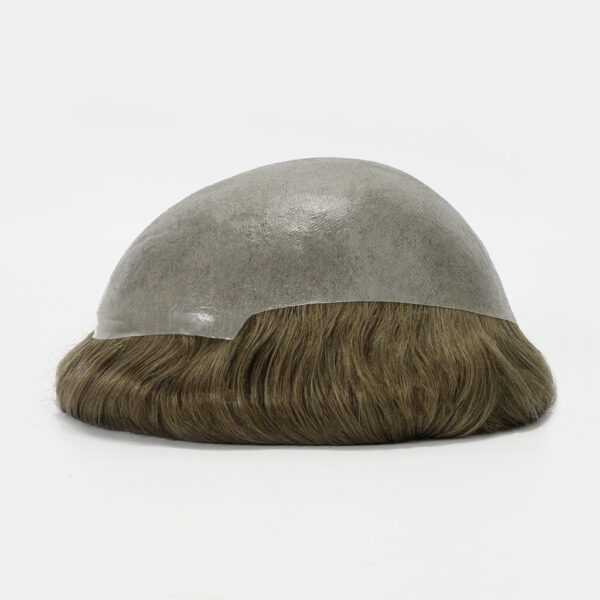
NEWTIMES HAIR’s VADON-M, HS1M, and HS1 use a 0.08 mm knotted thin-skin base with a 1/2-inch V-looped front hairline. The front is designed for a more natural appearance, while single split knots through the rest of the base provide additional support.
VADON-M is specified at 120% density, making it suitable for clients who want a naturally fuller style and more flexibility for longer hair.
For a broader explanation of replacement timing, maintenance, and base lifespan, see How Long Do Hair Systems Last?
(Click the product for more details)
Are Skin Hair Systems Breathable?
The short answer is yes, they are. Skin hair systems are way more breathable than you might think. They’re not like wrapping your head in a plastic bag that traps air. Before jumping to conclusions, you must check this out about skin hair systems.
Hair Density and Length: Do Not Confuse Them with Base Thickness
Base thickness and hair density are two separate specifications. For example, 0.06 mm describes the thickness of the PU skin base, while 100% describes the amount of hair ventilated into the system. A 0.06 mm skin system is therefore not a “0.06 density” hair system.
For more guidance on choosing density for different clients, see our guide to low-density hair systems.
| Skin base | Approx. density guide | Hair-length guide | Practical note |
| 0.03 mm | Up to ~100% | Up to ~10 in / 25 cm | Best for naturalness; avoid very long, heavy styles |
| 0.06 mm | Up to ~110% | Up to ~16 in / 41 cm | More flexibility while keeping a thin-skin look |
| 0.08 mm | 120% for VADON-M; custom density may vary by order | Greater flexibility for long hair | Best support for fuller or longer custom styles |
These are approximate production-experience guidelines, not universal limits. Final specifications can vary with base size, ventilation method, curl, and the intended style. See NEWTIMES HAIR’s detailed density and length guide.
Thickness Is Not the Only Difference
A skin system may also be described as a PU hair system or poly skin hair system, but base thickness alone does not tell the full story. Ventilation construction affects how the hair is secured, how the hairline looks, and how much support the base can provide.
- 0.03 mm HS25V: V-looped ultra-thin skin
- 0.06 mm HS1V: V-looped super thin skin
- 0.08 mm HS1: knotted thin skin with a 1/2-inch V-looped front hairline
When comparing a V-looped hair system with a knotted skin construction, hair replacement professionals should consider both thickness and construction rather than using thickness alone as the deciding factor.
For a broader selection framework, see our hair system selection guide.
Thickness and Ventilation Must be Matched
Base thickness and ventilation method work together. V-loop ventilation is commonly used with 0.03 mm and 0.06 mm thin skin because it creates a knotless appearance without requiring thick material to secure injected roots. Injected hair generally requires a base around 0.08 mm or thicker, so the roots can be sealed securely.
A 0.08 mm system may also combine ventilation methods. For example, VADON-M uses a V-looped front hairline with single split knots through the rest of the base. This gives the front a more natural appearance while adding support elsewhere.
V-loop systems are generally more delicate than knotted systems. The right choice therefore depends on the client’s desired realism, density, hair length, styling habits, and expected lifespan.
For more detail on knots, V-loops and injected hair, see our guide to hair ventilation techniques.
Are Skin Hair Systems Breathable?
Skin bases are generally less breathable than open lace. Thinner skin may feel lighter and less substantial, while thicker skin can provide more support. Comfort also depends on base coverage, climate, scalp condition, attachment method, and maintenance frequency.
How Should a Hair Replacement Professional Choose the Right Thickness?
A practical consultation can start with one question: What matters most to this client – maximum invisibility, everyday balance, or greater durability?
A salon should match skin thickness with the client’s appearance, styling, and wear priorities.
| Client priority | Recommended starting point |
| Maximum naturalness and a knotless appearance | 0.03 mm or 0.06 mm V-loop |
| Naturalness with more everyday support | 0.06 mm V-loop |
| Fuller density and stronger base support | 0.08 mm knotted or mixed construction |
| Injected, flat styling | Usually 0.08 mm or thicker |
| Longer wear expectations | Consider thicker skin, mono or hybrid construction |
(This is a starting framework, not a replacement for checking the complete product specification.)
There is no single thickness that is best for every wearer. After identifying the client’s main priority, also check the ventilation construction, desired hairline, hair length, density requirements, and maintenance expectations before making the final recommendation.
Final Thoughts
The difference between 0.03, 0.06, and 0.08 mm skin hair systems is not simply which base is thinnest. Choose 0.03 mm for maximum invisibility, 0.06 mm for a balanced everyday option, and 0.08 mm when durability, support, longer hair, or fuller density matters more.
For the best recommendation, match the client’s priorities with base thickness, ventilation construction, hair length, and density instead of treating any one specification as the deciding factor.
Explore more NEWTIMES HAIR men’s hair systems for more base designs and stock options.
About the Author
Alf Hou is a hair replacement specialist at Newtimes Hair with industry experience since 2018. His work covers men’s hair systems, wigs, toppers, hair extensions, and the technical details behind product construction, selection, installation, and maintenance. Working closely with Newtimes Hair’s products and manufacturing processes, Alf shares practical insights to help salons, stylists, hair replacement professionals, and distributors make more informed product and service decisions.
Related reading: 3 Best Hair Systems With a Unique Front Hairline | What Is a Good Toupee, and What Is a Bad Toupee?
Frequently Asked Questions
I just purchased a .06 hair piece. Is there any way to make it a .08 density. I had a little bit of trouble with the website. If necessary call me at 347-849-0060. I don't think I ever ordered .06 density or send me an email. I've ordered from you in the past.
June 11, 2024 9:30 amHi Neil, thanks for leaving a message, I will inform our professional sale rep Claire to help you later~
June 11, 2024 9:50 amQuiero una de 8mm
April 23, 2024 8:24 amGracias por dejar un mensaje, le informaré a nuestro representante de ventas profesional Ivan para que lo ayude.
April 24, 2024 1:46 pmHow well do these work with long hair? What are the density limits for each one? What is the best adhesive to use with skin bases?
April 23, 2024 12:19 amHi, thanks for leaving a message, I will inform our professional sale rep Christina to help you.
April 24, 2024 1:45 pmThank you for you detailed explanation about the 0,03 0,06 to 0,08 foil thickness and the handling with my customers. Please give me just more information about different of the hair density from 0,03 to 0,06 and 0,08. can I check the density difference in weight of the hairpieces? How many gram ist each hairpiece? Best regards Robert
April 22, 2024 10:23 pmHi,thanks for leaving a message. I will inform our professional sale rep Emily to help you.
April 24, 2024 1:43 pmBom dia, vocês enviam para o Brasil. Quanto custa uma prótese de 0,06mm, com densidade de 100%. Obrigada
April 22, 2024 8:04 pmObrigado pela sua pergunta, sim, podemos enviar para o Brasil, deixarei que nossas vendas entrem em contato com você.
April 24, 2024 1:41 pm