

Out of Stock Before Appointment – How Should Hair Replacement Centers Handle this Critical Situation for Scheduled Hair Appointments
Hair system out of stock before an appointment. How’s that?
When a client’s usual men’s hair system is unavailable before a booked fitting, first confirm whether or not the specific model you normally use will arrive in time for the scheduled fitting. If not, the stylist or owner can assess an alternative model that may arrive in time for the scheduled fitting. If neither option is appropriate, you and your client need to consider whether you can continue to use the client’s current hair system until you have time for another hair replacement appointment.
Assume your regular client is coming in for a Friday appointment and his usual hair system is temporarily out of stock. You can get an alternative hair system delivered the same day. Does it have the same base, color, percentage of gray hair, and hair density as the client’s normal hair system? Will it need to be cut? Will there be time to prepare and inspect the hair system that arrives on Friday morning?
Hair replacement centers (HRCs), professional hair replacement studios and hair replacement stylists need to consider whether another hair replacement product is going to solve the client’s problems or perhaps even create a further problem at the time of fitting the new system.
1. Hair System Out of Stock: Start With the Client’s Approved Specification
Before looking for another model, recollect all relevant orders and appointments of the client from the past. As mentioned above, the full order (name and SKU of the hair system) is a useful starting point, but it may not contain all the information from previous fittings of a client. Check them against the client’s specification sheet, consultation notes, and approved photos where available. Record any changes made since the last fitting.
For a regular client, check the specifications that affect coverage, attachment, appearance, and styling:
- Coverage and base size: The base dimensions and shape of the thinning area that needs to be covered by the hair system.
- Base construction and front hairline: Length, perimeter, and the construction of the base, the shape of the front hairline, the type of attachment requirements, and the hairstyle that the client wants to wear.
- Hair color and gray blend: Appointed hair color in terms of color code, as well as percentage of gray hair and type of gray strands (e.g., human hair, synthetic hair, etc.).
- Density: The fullness and distribution of hair in the hair system, particularly across the front, top, and crown, considered alongside the client’s remaining hair.
- Hair type and styling characteristics: Length of hair, curl or wave pattern of hair, hair texture and direction.
Divide these details into three categories: things that have to remain unchanged, things that can be changed as long as the stylist agrees, and things that have to be confirmed.
Just because another Hair System has the same base type does not mean that it can be used as a substitute for the original Hair System. It may have a different Front Contour, Density, or even Hair Direction, for example.
Refer to Newtimes Hair’s Men’s Hair System Selection Guide for a full list of factors to consider when choosing the best hair system. These include base size, base type, hair color, hair type, hair density, curls and waves, hair direction, and front hairline.
2. Work Backward From the Fitting Date
The delivery date is only part of the overall schedule. If a hair system is to arrive at the HRC before an appointment, that must leave sufficient time for a stylist to inspect the item and to prepare it for the client’s fitting.
Set three deadlines before ordering:
| Deadline | What it means |
| Client appointment | The scheduled fitting time |
| Latest workable arrival | The latest time the unit can reach the center or studio while leaving enough time for inspection and preparation |
| Decision deadline | When the salon or center must confirm the replacement plan or arrange another appointment |
All work can take place after delivery to a studio, such as checking a base, checking a color, checking a front hairline, etc., then cutting a base, styling the hair system, and preparing the system for a hair system fitting.
To illustrate, a Friday morning arrival at the studio may not be useful for a Friday morning appointment with the client, especially if some work (such as cutting the system) is required or the stylist has not had time to check the specified hair system against the supplier’s provided information and approve it for use.
For salons with large teams of people, it’s best to assign one person to contact and place the supplier order, get the stylist to assess the client, and then update them and confirm the supplier’s order with the supplier. This way, the supplier will get the correct information from one person, as opposed to studio owners/employees getting the stylist to contact the supplier for the owner.
3. Confirm the Actual Fulfillment Route
Before agreeing to express delivery, find out from the supplier what he can deliver.
A product advertised in a supplier’s catalogue may be shown in the exact color, size, and product configuration, but this does not mean a finished stock unit in that specification is available. It could be a standard model that is temporarily out of stock and needs manufacturing, or a fully customized system requiring production before dispatch to your salon.
According to Newtimes Hair’s ordering FAQs, stock hair systems are pre-made and ready to ship upon purchase, while custom systems are made to order. Standard models that are temporarily out of stock may also need to be manufactured before dispatch.
Stock availability in a particular color, size, and model should be confirmed before ordering. You can check the supplier’s website or contact customer service, but confirm the exact variant and quantity directly with the supplier.
For registered Newtimes Hair wholesale customers with access to the Real-time Inventory Update feature, use it as an initial check of supplier inventory for the required specification. Then contact your Newtimes Hair representative to confirm the exact model and variant, available quantity, fulfillment location, and whether the unit is finished and ready to dispatch. Treat the inventory display as an initial availability check, not as a reservation or dispatch confirmation. If you need the unit held while confirming the appointment plan, ask whether a reservation is possible and for how long.
When contacting the supplier, confirm the following:
- Is the exact model/variant finished and physically in stock?
- How many units are available?
- Which warehouse or location will fulfill the order?
- The expected dispatch date and delivery estimate.
- The order cutoff for the proposed shipping service.
- The delivery charge and any additional fees.
- Do they need hair cutting, base cutting, or styling before dispatching the units?
- Can we send the critical hair appointment item(s) separately from the rest of the order if completed earlier?
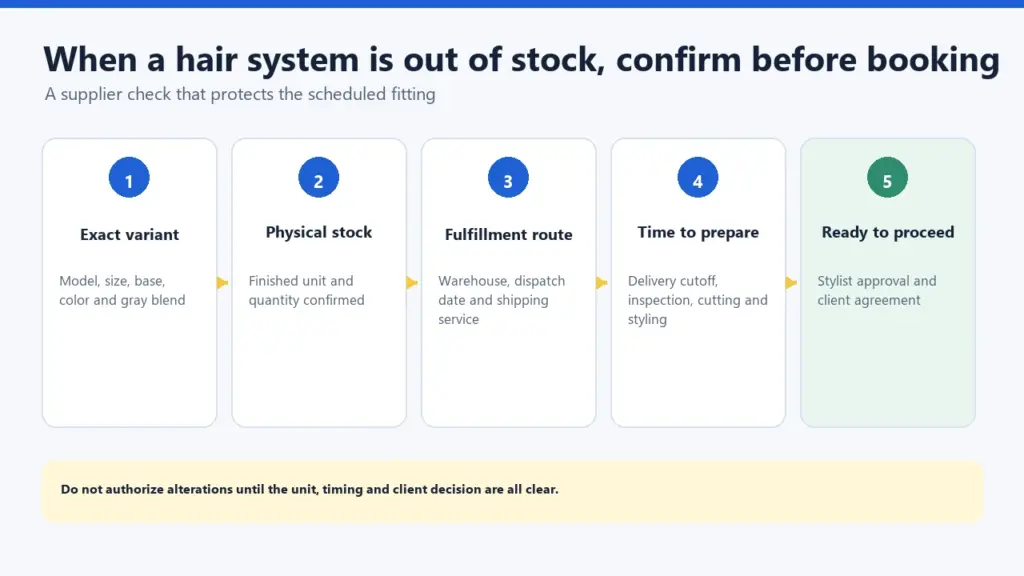
For an urgent appointment, ask the supplier to confirm the availability check in writing, including the date and time it was made. If the unit can be reserved while the client reviews the alternative, ask how long the reservation can be held. Do not assume that an inventory display or verbal availability check means the unit has been reserved.
You must distinguish between the dispatch time of the supplier, the transit time of the chosen shipping service, and the preparation time of the supplier for the order. The supplier’s FAQ mentions an additional 1–3 working days on top of the processing time for additional services such as cutting the hair or trimming the base of the stock hair systems.
For U.S. orders, Newtimes Hair lists standard two-day nationwide delivery from U.S. inventory, paid next-day FedEx delivery, same-day Uber delivery for Los Angeles-area customers for an additional fee, and scheduled pickup by appointment for professionals at the California warehouse. The Florida warehouse supports nationwide shipping only.
For an appointment that is already at risk, ask which option can deliver the exact unit within your remaining preparation time. Confirm availability, destination, cutoff time, fees, and the actual arrival estimate before promising the fitting. See our U.S. warehouse and delivery page for current service details.
These are fulfillment options, not a guarantee that every model and specification is available. You will need to confirm the exact unit, destination, cut-off time, and any applicable fee for the selected delivery service.
Custom orders are used to create hair systems that are outside of the normal stock products, but they are generally not suitable as last-minute emergency hair systems. If you are considering an emergency custom hair order, the supplier must have given you a realistic production and shipping time frame.
4. Compare the Four Realistic Appointment Options
After establishing whether all of your required aspects will be covered and how much time you need for any required cutting and preparation, you compare the four realistic appointment options.
| Option | When it may work | What must be established |
| Exact specification through another fulfillment route | The usual warehouse or supplier cannot fulfill the order, but another location has the correct unit | Exact specifications, confirmed availability, arrival time, and preparation time |
| Different stock model | The original unit is not available for the required time, but a different model is a suitable alternative | The differences in construction and appearance, in terms of styling, and that the client would approve of the alternative model |
| Maintenance of the existing system | The current unit is still suitable for the proposed service | Its actual condition, what maintenance can achieve, and the next replacement plan |
| Reschedule the replacement fitting | No matching unit available for immediate inspection and preparation | Realistic supply times and an agreed new appointment with client |
Do not be misled into thinking that only the price of the replacement unit needs to be taken into account. In fact, you must compare the total cost for each of the options available for purchasing and for any subsequent use of your studio’s services (cutting, base preparation, styling, etc.) as well as the amount of time you and your staff will have to spend.
The costs and commercial considerations to compare include:
- Replacement unit price.
- Express shipping and other delivery charges.
- Paid cutting, base preparation, or styling services.
- Additional salon time and staff involvement.
- An extra client visit, if one is required.
- The commercial implications of it not working, a poor substitute, or an unsuccessful fitting.
For a more consistent comparison, calculate the estimated cost of each replacement option using the same method:
Estimated fallback cost = replacement unit price + delivery and applicable fees + paid preparation services + additional salon labor + any extra visit or rework costs.
Include applicable taxes and duties where relevant. Count each charge only once, and mark unconfirmed charges as “quote required” rather than treating them as zero. Compare maintenance of the existing system separately, since it may avoid the replacement unit cost but still involve additional salon time and a follow-up appointment.
This is a practical comparison method, not a Newtimes Hair pricing policy. Newtimes Hair’s sample and pilot testing guide also explains why product, freight, applicable duties, inspection and preparation labor, and rework should be considered when comparing the total cost of a hair system.
Express delivery may shorten transit time, but it cannot solve a stock mismatch or remove the preparation time needed at the salon. Paying extra to rush an unsuitable substitute does not protect the appointment.
Note that maintenance of an existing system may be a temporary solution and has to be recommended by a stylist who is sure that the proposed service is suitable for the current system. Are there any specific promises regarding an extension of wear?
5. Check the Substitute Against the Client’s Requirements
Just because a substitute product looks like the original photo does not mean it will be an acceptable alternative. It must also be checked against the original product’s full specifications so the stylist can identify any differences.
| Specification | What the stylist should check |
| Base size and shape | Will the hair system cover the area required and can any necessary alterations be made within the permitted cutting limits of the base? |
| Base construction and front hairline | Is the construction of the substitute unit compatible with the attachment method and hairstyle of the originally supplied system? Does the front of the unit approximate the correct hairline for the wearer? |
| Color and gray blend | Does the physical color match the client’s surrounding hair, including the gray percentage and fiber type? |
| Density | Does the fullness and distribution blend with the client’s remaining hair? Is the front density appropriate? |
| Hair length, curl, and direction | Is there enough hair to achieve the intended cut, parting, and styling? |
Color deserves particular attention. There is also the consideration that color may look different under the salon lighting and next to the client’s own hair.
Newtimes Hair’s professional hair color charts are provided to help Salon Owners compare colors and to order from our hair color tools section. The color rings and hair samples make great additions to your Salon’s hair color consultation process. Use a physical color ring or a hair sample from the client to compare colors, as screen settings can make colors look different.
The same applies to matching gray hair. A difference of a small percentage of gray in the hair color number does not automatically mean that it will work for every customer.
Don’t compare only the overall density label. Check how the hair is distributed across the front, top, and crown, particularly where the system needs to blend with the client’s remaining hair. Also compare the front contour, hairline transition, ventilation, and hair direction. Two products with similar labels may still look different when worn or styled.
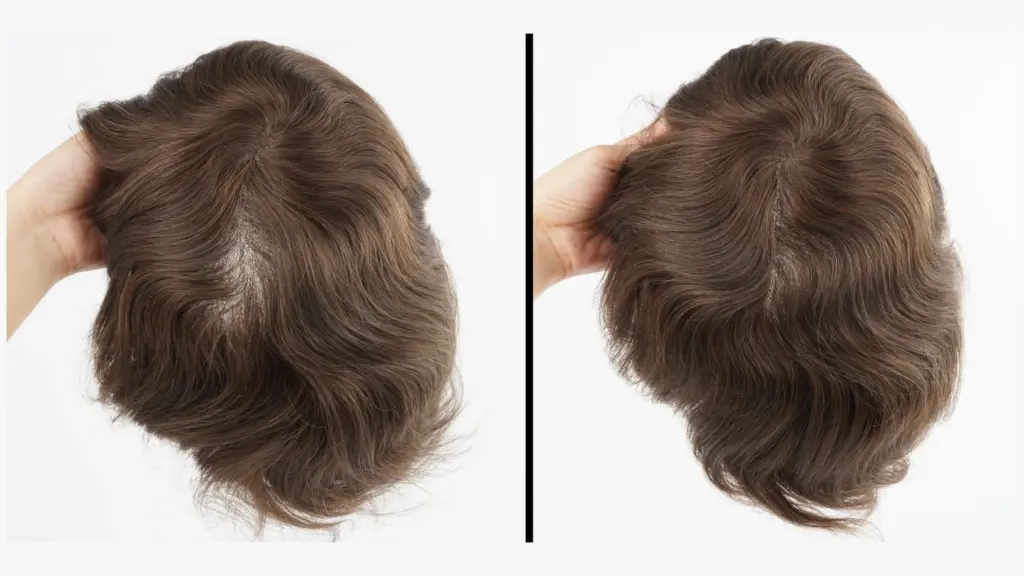
Newtimes Hair’s sample and pilot testing guide explains why base construction, front contour, ventilation, color, density distribution, and workmanship should be evaluated together rather than as isolated specifications.
If the alternative requires a change that has not yet been assessed and approved by the stylist, do not treat it as an approved alteration. Revert back to the other available times for the reappointment.
6. Explain the Proposed Change Before Authorizing Alterations
You should explain any alternatives found by the stylist to use to complete your appointment before any irreversible preparation is carried out, such as authorizing cutting or pre-styling.
The client should understand:
- Are we trying to find the exact system, or are we looking at alternative models?
- Which differences may affect appearance, fit, or maintenance?
- Whether additional preparation is required.
- Any additional charges.
- Whether the original appointment can still be kept.
A straightforward update could read:
Your normal system is currently out of stock. I will investigate if we can get the exact system to you in time for us to be able to inspect and prepare it for fitting. In the meantime, I have found an alternative. There are some differences between this and your normal system, which I will outline to you and explain the differences, cost, and anticipated time frame. The alternative may not be suitable, and we can arrange an alternative appointment should neither of these options be suitable. I will be in touch by [day and time].
Record their agreement and proposed changes as a salon would record a change in a different preparation service (i.e. to affect appearance).
Be sure to check the supplier’s terms and conditions for return prior to making any alterations to their product. Newtimes Hair’s pre-cut service information states that prestyled products and products with add-on services are not returnable. The general stock return conditions and custom-order return conditions are different for Newtimes Hair as well. Be sure to check which terms and conditions apply before authorizing any work to be done to a replacement product.
A return restriction and a manufacturing-defect claim are not necessarily the same issue. Newtimes Hair’s FAQ states that its three-month warranty covers in-stock hair systems, regular stock orders, and custom-made systems. It also states that a quality issue caused by a manufacturing defect within the warranty period can be repaired free of charge. This does not mean that every difference or dissatisfaction automatically qualifies as a manufacturing defect; the specific issue must be assessed under the applicable terms.
If the delivered unit differs from the approved specification or shows a possible workmanship problem, photograph its condition on arrival before cutting, washing, coloring, bonding, or wearing it. Keep the order reference, SKU, approved specification, and photographs together. Contact the supplier to confirm the reporting process, supporting evidence, and possible remedy for that particular order.
7. Inspect the Actual Unit Before the Fitting
The notification of delivery does not mean that the replacement has been inspected for quality. This is to be checked by the stylist prior to any further alteration or fit.
The stylist should check:
- Model and variant against the confirmed order.
- Base dimensions, shape, and visible construction.
- Front contour and hairline.
- Hair color and gray blend against the client’s approved reference.
- Density and its distribution.
- Hair direction, length, and curl or wave pattern.
- Visible condition, workmanship, and packaging.
For a more detailed inspection, Newtimes Hair’s sample and pilot testing guide identifies the following areas for checking a hair system against its written specification:
| Inspection area | What to check |
| Base | Dimensions, shape, edges, material, thickness where specified, seams, tears, holes, and perimeter construction |
| Hairline | Front contour, density transition, root visibility and suitability for the intended hairstyle |
| Ventilation | Hair direction, parting, crown pattern, knot or root appearance and consistency across zones |
| Color | Match against the approved physical reference under consistent lighting, including roots, lengths, highlights, and gray distribution where relevant |
| Density | Overall fullness and density distribution, especially at the front and areas that need to blend with the client’s remaining hair |
| Workmanship | Loose threads, irregular edges, tangling, unexpected residue, uneven finishing, shedding, packaging and labeling |
Agree on the relevant specifications and tolerances before approving the replacement. Assess the hairline both close up and at normal viewing distance. Check density by zone rather than relying on overall fullness alone.
Take photographs of any variations to the approved order, including the model or SKU and relevant specification. Make sure the unit is left untouched and contact the supplier as soon as possible to inform them of any differences and the way forward for the completion of the replacement fitting appointment.
All three points must be covered before moving on to the appointment for the alternative model to be fitted:
- The stylist has approved the product, based on his/her inspection of the shipped items.
- There is enough time to properly complete all necessary work.
- The client has agreed to any relevant differences, costs, and changes.
One thing is for sure: a parcel arriving on time is not the same as a fitting being ready to proceed!
In case the customer considers the possibility of Hair System Maintenance instead of Hair System Replacement, assess the client’s current Hair System first and clearly outline the limitations of the proposed service. Set a date for the replacement of the maintained Hair System and inform the customer when he/she can expect the new product.
8. Record the Decision for the Next Appointment
The brief details of the issue need to be recorded for future reference.
Record whether or not a specified model was available, what alternative(s) you considered, what that stylist agreed to, what that client agreed to, and what worked for the fulfillment of that appointment.
For repeat clients, record the approved specification(s) and also list any acceptable alternatives. This will ensure that even if an alternative was used on a previous occasion, it will not automatically be selected if the client’s requirements have changed.
A simple appointment-recovery record can make this information more useful for the next urgent replacement. It is a recommended record for the salon, not an existing Newtimes Hair account feature.
| Record | What to capture |
| Original requirement | Client’s usual model, SKU, and approved specifications |
| Appointment deadline | Original appointment date and latest workable arrival |
| Availability check | Date and time checked, available quantity, stock status and warehouse |
| Supplier confirmation | Written dispatch estimate and any confirmed reservation |
| Fulfillment | Shipping service, quoted arrival date and actual arrival |
| Preparation | Cutting, styling or other add-on services and time required |
| Suitability and approval | Specification differences, inspection photographs, stylist approval and client agreement |
| Cost | Unit, delivery, preparation, additional salon labor, and any extra visit or rework |
| Final outcome | Whether the fitting proceeded, was rescheduled, or required further follow-up |
Over time, these records can help a salon compare quoted and actual delivery times, preparation requirements and fallback costs. They can also show which alternatives have been accepted for particular client requirements.
For the broader business, including core inventory, supplier-held stock and reorder points, see Newtimes Hair’s guide to preventing hair system stockouts. This covers the wider inventory-planning process, while the present article focuses on handling an appointment that is already at risk.
For broader inventory planning, including how to divide core stock between your HRC and supplier inventory, and how to set reorder points, see our guide to preventing hair system stockouts.
Need Help Finding a Replacement Hair System?
If a client’s fitting is approaching and the usual model is unavailable, please forward the complete requirements to the Newtimes Hair representative (e.g., style, Base specs, Hair specs, Quantity, and Destination postcode).
- Usual model and SKU.
- Base type, size, and shape.
- Hair color and gray percentage.
- Density and hair type.
- Hair length, curl or wave, and hair direction.
- Required quantity and destination postcode.
- Latest workable arrival date.
- Any requested hair cutting or base-cutting service.
What specific requirements need to stay the same and what can be adjusted by the stylist.
Ask your Newtimes Hair representative to check for an exact match first and list out the alternatives available for your stylist to consider for any differences. For U.S. orders, Newtimes Hair’s U.S. Warehouse team can assist with verifying available options to fulfill specific requirements.
Don’t allow one stock shortage to cause another problem. Confirm whether an available hair system is suitable and make a decision as soon as possible. Only proceed with a replacement when the stylist has approved its suitability and the client has agreed to any relevant differences.