




- Why Hair System Stockouts Are Hard to Predict
- Build a Two-Level Inventory Model
- Set a Reorder Point Before You Run Out
- For U.S. HRCs, Local Stock Only Helps If the Exact System Arrives in Time
- Ask for Exact Availability, Not Just Total Inventory
- Build an Appointment-Safe Replenishment Process
- Choose a Supplier Based on More Than Inventory Volume
- Check Your Next Replenishment Before You Need It
- Frequently Asked Questions
How Can Hair Replacement Centers/Studio Prevent Hair System Stockouts?
- Why Hair System Stockouts Are Hard to Predict
- Build a Two-Level Inventory Model
- Set a Reorder Point Before You Run Out
- For U.S. HRCs, Local Stock Only Helps If the Exact System Arrives in Time
- Ask for Exact Availability, Not Just Total Inventory
- Build an Appointment-Safe Replenishment Process
- Choose a Supplier Based on More Than Inventory Volume
- Check Your Next Replenishment Before You Need It
- Frequently Asked Questions
A men’s hair system stockout can do more than delay one product sale. It can force a hair replacement center/studio to reschedule a client, delay a fitting, or recommend a product that does not match the client’s needs.
The most reliable way to reduce stockout risk is to combine four practices:
- Keep core, frequently used specifications in your own inventory.
- Use a supplier that carries a wider range of ready-to-ship systems.
- Set a reorder point before inventory reaches zero.
- Confirm exact availability and arrival timing before promising a client.
No supplier can eliminate every stockout. Demand changes, and popular specifications can sell faster than expected. The practical question is whether your inventory process gives you enough time and replenishment options to respond.
This guide is for small professional stores managing cash flow, growing HRCs protecting service continuity, and larger centers evaluating supplier reliability.
Why Hair System Stockouts Are Hard to Predict
Men’s hair replacement systems are not a single product category. Each client may require a different combination of:
- Base type
- Base size
- Hair color
- Density
- Hair length
- Hair direction
- Curl or wave pattern
- Gray-hair percentage
- Standard or custom specifications
An HRC may know which products are generally popular, but it cannot efficiently hold every possible combination. Keeping too much inventory ties up cash and creates slow-moving stock. Keeping too little increases the chance that a client appointment will arrive before the correct system does.
The problem becomes more serious when an appointment already exists. A supplier may have inventory somewhere in its network, but that inventory only helps if the exact specification can arrive before the client needs it.
Build a Two-Level Inventory Model
Your HRC does not need to hold every possible hair system specification. A more practical model divides inventory responsibility between your business and your supplier.
| Inventory Layer | What Should it Cover | Main Purpose |
| HRC core inventory | Frequently used bases, colors, sizes, and densities | Protect regular appointments |
| Supplier inventory | Less frequent or longer-tail specifications | Expand product choice without excessive overstock |
| Custom orders | Rare or highly specific requirements | Handle needs that should not be treated as immediate stock |
Your own inventory should protect the services and specifications you use repeatedly. Your supplier should help cover the wider range of specifications that you cannot reasonably keep on hand.
This approach is especially relevant for small professional stores, where cash flow and storage space are limited. It also helps growing or multi-location HRCs maintain service continuity without duplicating every specification at every location.
Newtimes Hair’s public in-stock men’s hair systems page currently states that approximately 80,000 men’s hair systems are in stock and ready to ship. The page also lists thin-skin, French lace, Swiss lace, monofilament and hybrid systems.
However, total inventory does not mean that every base, color, density, or size is available at all times. HRCs should confirm the exact specification before promising a client an appointment date.
See the in-stock men’s hair systems page for the current public information.
Set a Reorder Point Before You Run Out
A reorder point should be based on usage, confirmed appointments, and replenishment time—not on guesswork.
A simple formula is:
Reorder point = expected use during the replenishment window + safety stock
For example, if an HRC normally uses four units per week, the confirmed replenishment window is two weeks, and the business keeps two additional units as safety stock, the reorder point would be ten units.
This is only an example. Each HRC should calculate its own reorder point based on actual usage, appointment volume, supplier availability, and delivery time.
Review your inventory at three levels:
- Normal: Core stock covers upcoming appointments.
- Watch: Stock is falling, so exact supplier availability should be checked.
- Urgent: An appointment is approaching, so the fastest confirmed delivery or an approved alternative is needed.
The important rule is simple: check supplier availability before the final unit has been assigned to a client.
For U.S. HRCs, Local Stock Only Helps If the Exact System Arrives in Time

For an HRC, supplier inventory is only useful if the correct system can arrive before the client’s appointment.
Local inventory can shorten the replenishment path, but it does not guarantee that the exact base, color, density, or size is available. Before making a client commitment, confirm:
- The exact product specification
- Available quantity
- Shipping location
- Delivery method
- Additional delivery fee, if applicable
- Expected arrival date
- Whether the item is a stock hair system or a custom order
Newtimes Hair’s public U.S. warehouse page currently lists:
- California and Florida warehouse locations
- Standard two-day delivery nationwide from U.S. inventory
- Next-day FedEx delivery for an additional fee
- Same-day Uber delivery for Los Angeles-area customers when the matching item is available
- Scheduled on-site pickup at the California warehouse for professional customers
- Nationwide delivery from the Florida warehouse, with no on-site pickup listed there
These options are subject to exact product availability, order confirmation, destination, cutoff time and applicable fees.
See the Newtimes Hair U.S. warehouse and delivery page for the current public information.
The value of local inventory is not simply that shipping may be faster. It is that an HRC may have more than one replenishment option (including supplies) when a normal inventory plan is no longer sufficient.
Ask for Exact Availability, Not Just Total Inventory
A supplier may have a large inventory overall while being out of stock in the exact specification you need.
When asking a supplier to confirm availability, send the complete product information:
- Base type
- Base size
- Hair color
- Density
- Hair length
- Hair direction
- Quantity
- Destination
- Required arrival date
Then ask:
- Is the exact specification finished and ready to ship?
- From which warehouse will it ship?
- What delivery methods are available?
- What is the expected arrival date?
- If it is unavailable, is there an approved alternative?
- Is the item a stock system or a custom order?
If your professional account provides live or regularly updated inventory information, use it as part of your reorder process.
If you do not have direct inventory access, ask the supplier to confirm the exact specification in writing before placing an urgent order.
Inventory information is most useful before the final unit has been assigned to a client. Checking early gives HRC more choices than waiting until the product is already needed.
Build an Appointment-Safe Replenishment Process
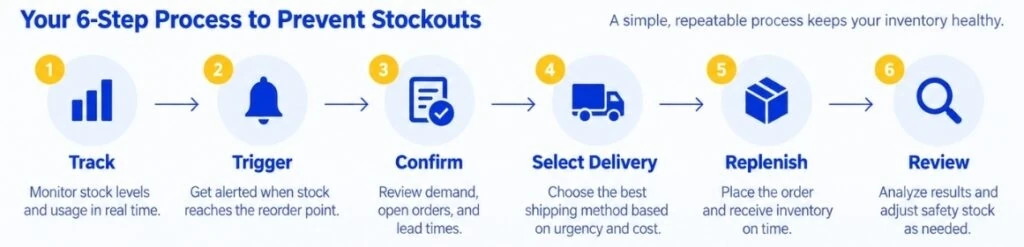
A simple internal process can reduce last-minute confusion:
Track → Trigger → Confirm → Select delivery → Replenish → Review
- Track Usage by Exact Specification
Do not track only “men’s hair systems.” Track the combinations that affect client service, such as base type, color, density, and size.
- Identify Your Core Products
Identify the products used most often and review them more frequently than slow-moving items.
- Check Supplier Availability at the Reorder Point
Confirm exact stock, warehouse location, delivery method, and expected arrival date.
- Match the Delivery Method to the Urgency
Use normal delivery for planned replenishment. Use expedited delivery only when the appointment timeline justifies the additional cost.
- Keep an Approved Alternative List
For selected services, document which bases, colors, or densities can be substituted without compromising the expected result.
- Record Each Urgent Replenishment
After an urgent order, record what happened. Over time, these records can help improve reorder points and identify specifications that need stronger inventory coverage.
Choose a Supplier Based on More Than Inventory Volume
A large inventory number is useful, but it is not enough by itself.
A stronger supplier evaluation should include:
- Product and batch consistency
- Ready-to-ship inventory
- Clear distinction between stock products and custom orders
- Predictable delivery options
- Flexible replenishment
- Product education and operating guidance
- Clear returns, warranty, and after-sales procedures
- Defined communication and escalation contacts
- Transparent cooperation boundaries
The right inventory support also depends on the type of HRC.
Small professional stores usually need low-risk purchasing, flexible replenishment and clear basic support. Growing HRCs need service continuity, standardized product information and predictable supply. Strategic or multi-location centers need stronger evidence around quality consistency, delivery processes, customization boundaries, and escalation procedures.
The goal isn’t to pretenddemand is perfectly predictable. The goal is to make sure your business can respond when demand is not.
Learn more about how to choose a hair system.
Check Your Next Replenishment Before You Need It
Planning your next replenishment?
Send Newtimes Hair the exact base type, size, color, density, quantity, destination, and required arrival date. The team can confirm current availability and the delivery options applicable to your order.
Check in-stock men’s hair systems
Review U.S. warehouse delivery options