



- Quick Answer: Stock or Custom Hair System?
- What Is a Stock Hair System?
- Why Stock Hair Systems Are Usually Better for First Orders
- When Stock Hair Systems Work Best
- Main Types of Stock Hair Systems
- What Is a Custom Hair System?
- When Custom Hair Systems Are the Better Choice
- Stock vs. Custom Hair Systems: The Real Difference
- The Best Ordering Strategy for Salons
- Pre-Order Checklist: What to Confirm Before Buying
- Which One Should You Choose?
- FAQs
Stock Hair Systems vs. Custom Hair Systems: Which Should Salons Order First?
- Quick Answer: Stock or Custom Hair System?
- What Is a Stock Hair System?
- Why Stock Hair Systems Are Usually Better for First Orders
- When Stock Hair Systems Work Best
- Main Types of Stock Hair Systems
- What Is a Custom Hair System?
- When Custom Hair Systems Are the Better Choice
- Stock vs. Custom Hair Systems: The Real Difference
- The Best Ordering Strategy for Salons
- Pre-Order Checklist: What to Confirm Before Buying
- Which One Should You Choose?
- FAQs
Choosing between a stock hair system and a custom hair system is not just a product decision. For salons, barbers, clinics, and hair replacement studios, it is also a timing, risk, client-satisfaction, and reorder decision.
The simple answer is this:
Choose stock hair systems when you need speed, lower first-order risk, or a fast quality test. Choose custom hair systems when the client needs a highly specific base size, contour, density, curl, color blend, grey percentage, or hair direction.
Based on Newtimes Hair’s internal VOC analysis, first-order problems are often not caused by “stock vs. custom” alone. They are more often associated with refund friction, quality inconsistencies, color or grey mismatches, thinness, tangling, durability, and delivery expectations. That is why the safest buying path for many professional buyers is:
Start with stock → validate quality and color → move to semi-custom → use full custom for repeat or complex cases.
Below is a practical guide to help you decide which option fits your client, your timeline, and your salon workflow.
Quick Answer: Stock or Custom Hair System?
Follow this brief table to choose between stock or custom hair systems.
Situation | Best Choice | Why |
First order with a new supplier | Stock | Easier to test quality, color, density, hair feel, and durability before committing to exact custom specs |
Urgent salon appointment | Stock | Faster delivery matters more than perfect personalization |
Standard base size and common color | Stock | Good balance of speed, value, and predictability |
Complex grey, salt-and-pepper, or mixed color | Custom | Better when supported by a hair sample, color ring, grey percentage, and grey distribution map |
Unusual head shape, scar coverage, or special contour | Custom | A template can improve fit and edge placement |
Repeat client with confirmed specs | Custom | Once the formula is proven, custom gives better repeatability |
Urgent but complex case | Stock now + custom reorder | Protect the appointment first, then refine the long-term solution |
What Is a Stock Hair System?
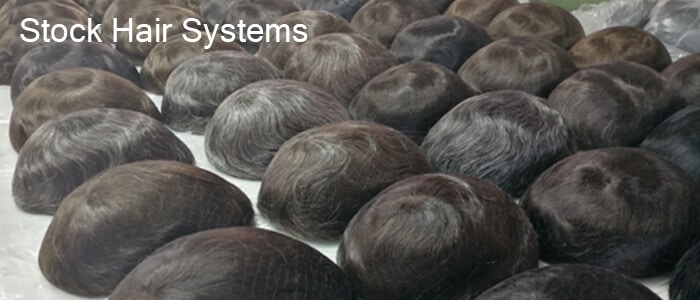
A stock hair system is a ready-made hair replacement unit produced in popular base designs, sizes, densities, colors, and hair lengths. Because it is already made, an available stock unit can usually ship much faster than a custom-made order.
For salons, this is the biggest advantage. When a client has an appointment booked, a wedding coming up, a sudden replacement need, travel plans, or a failed unit from another supplier, waiting several weeks for custom production may not be realistic.
Stock hair systems are especially useful when:
- The client has a common hair color.
- The client can use a standard or adjustable base size.
- The salon can cut the base down to fit.
- speed matters more than a highly specific design;
- The buyer wants to test supplier quality before placing custom orders.
Many Newtimes Hair men’s stock systems are made in standard professional sizes, commonly around 8”x10”, with selected models available in other sizes such as 6”x8”, 6”x9”, 7”x10”, and 8”x10”, depending on the model and market. Stock units are also commonly offered in practical salon specs such as 5” hair length, popular wave patterns, and frequently ordered colors.
The key point is not that stock fits everyone perfectly. It does not. The key point is that stock gives salons a fast, practical starting point.
Why Stock Hair Systems Are Usually Better for First Orders
For a first order, the biggest risk is often uncertainty. The salon may not yet know how the supplier’s hair feels, how the density compares with its current supplier, how the color chart translates in real life, or how the unit performs after washing, styling, and client wear.
That is why stock is usually the safer first step.
Based on internal VOC analysis, refund-and-return-related dissatisfaction is the strongest negative signal, while tangling, dryness, thinness, durability, grey mismatch, shipping delay, and color mismatch are also important complaint drivers. In practical terms, this means a salon should try to avoid making the first order too complicated.
A stock trial order lets the salon check:
- hair softness and movement;
- color accuracy against the salon’s clients;
- density and thickness;
- base comfort and breathability;
- shedding and tangling behavior;
- how the system performs after washing or light styling;
- delivery speed and packaging quality;
- whether the return or exchange process is clear.
Once these basics are proven, it becomes much safer to move into custom specifications.
When Stock Hair Systems Work Best
Stock hair systems are best when the case is standard, urgent, or low-risk.
1. Urgent Salon Orders
If the client’s appointment is already booked, stock is usually the better choice. A custom system may give a closer specification match, but it cannot help if it arrives too late.
For urgent replacement cases, salons should prioritize:
- available inventory;
- local warehouse options where possible;
- realistic shipping time;
- a base that can be cut down;
- a color close enough for immediate use;
- a custom reorder plan for the next unit.
A useful salon rule is:
Use stock to save the appointment. Use custom to perfect the repeat order.
2. First-Time Supplier Testing
Before a salon commits to regular custom orders, stock can be used as a quality benchmark. This is especially important for wholesale buyers who need consistency across multiple clients.
A small stock order can answer questions that a product description cannot:
Does the hair feel natural?
Is the density realistic?
Does the base match the photos?
Does the hair tangle too quickly?
Is the color chart reliable?
Does the supplier ship as expected?
3. Common Colors and Standard Base Requirements
If the client’s color, density, hair length, and base size are common, stock can be a smart choice. Many clients do not need a fully custom unit for every order, especially if the salon can trim, cut in, style, and blend the system professionally.
Main Types of Stock Hair Systems
Newtimes Hair’s stock hair systems are commonly grouped by base material. Each base type has a different balance of natural appearance, breathability, durability, and attachment convenience.
Skin Hair Systems
Skin hair systems use a polyurethane-style base. They are popular because they can create a very natural scalp appearance and are relatively easy to attach and clean.
Ultra-thin skin systems, such as very thin V-looped designs, are often chosen for clients who want the most natural-looking hairline. The trade-off is durability. In general, the thinner and more invisible the base, the more carefully it must be handled.
Slightly thicker thin-skin systems can offer a better balance between realism and lifespan. They may be suitable for first-time users because the base is easier to attach, remove, and maintain than some delicate lace options.
Best for:
- natural scalp appearance;
- easy attachment and cleanup;
- clients who want a clean, close-to-scalp look;
- salons needing a practical first-order option.
Watch out for:
- shorter lifespan in ultra-thin bases;
- heat, oil, adhesive, and removal technique affecting durability;
- less breathability than lace in hot climates.
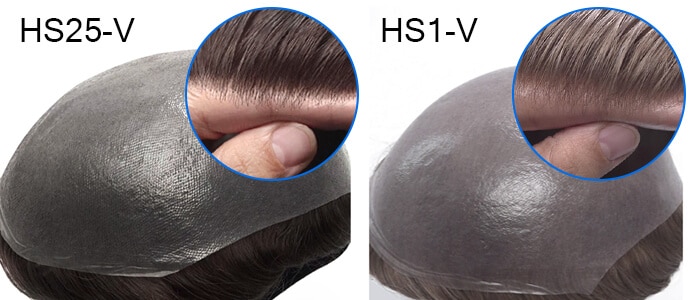
If you want a longer lifespan, and still after a super natural look, you should think about our HS1-V model. It has a 0.06mm super-thin skin base with V-looped hair all over. It only differs from the HS25-V by the thickness of the skin. Although it is twice as thick as the HS25-V, the difference is not so apparent. It will last up to 2-3 months, which is significantly longer than the HS25-V model. It is also suitable for a brushed-back style.
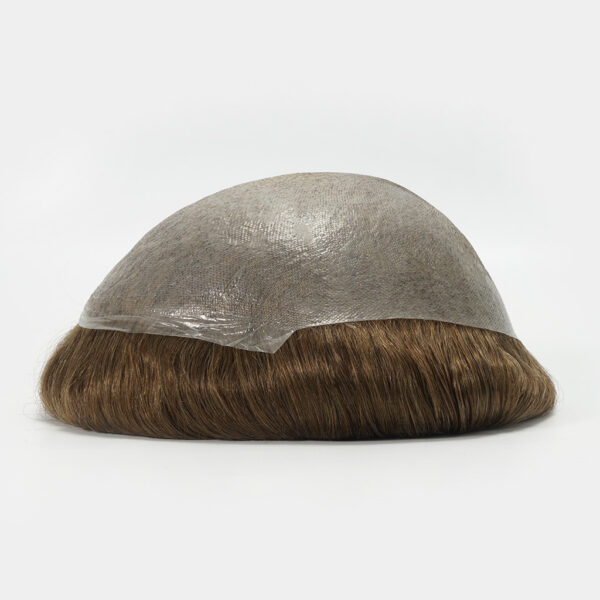
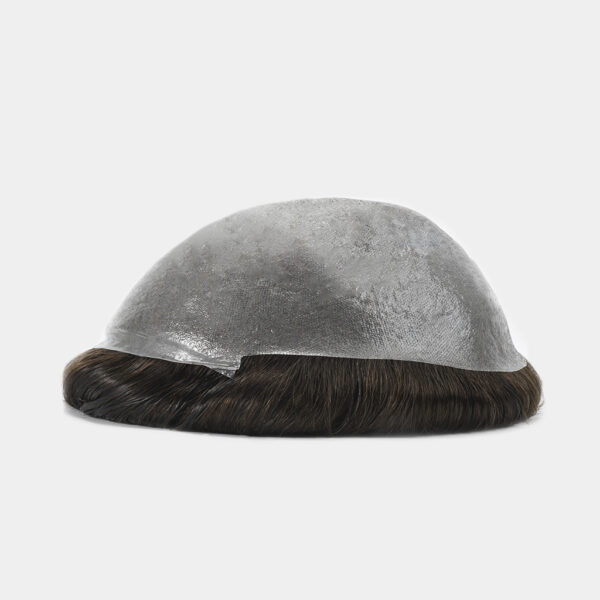
If you want a skin hair system, but a long lifespan is your top priority, then we recommend our HS1 model.
Our HS1 is our most popular stock skin model because of its natural-looking hairline and durability. It has a 0.08mm transparent thin skin base with V-looped hair on the first 1/4” of the front hairline to give a very natural hairline. The rest of the base has single split knots, which makes the hair system more durable. You can use glue to attach it to the head, and it is also a good choice for first-time hair system users. It can last about 5-8 months.
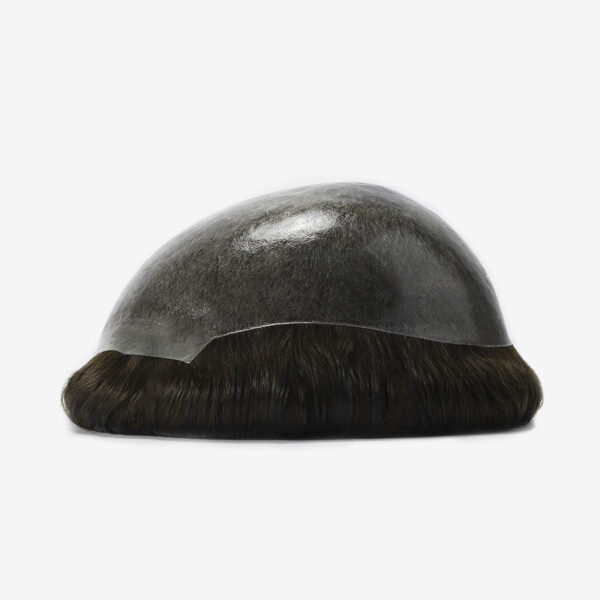
We also have another skin model in stock: INS. This is a 0.08mm transparent thin skin model with injected hair. Injected hair is injected into the base material without knots, which gives the appearance of naturally growing hair.
This is why clients like INS. It lasts for about 3-4 months. If you like very flat hair, this model is a good choice, and it is well-suited to a combed-forward hairstyle, but if you want a brushed-back style, then it will not be the best option. We offer this model in three colors: #1, #1B, and #2. If you want a lighter hair color, you will need to make a custom order.
Lace Hair Systems
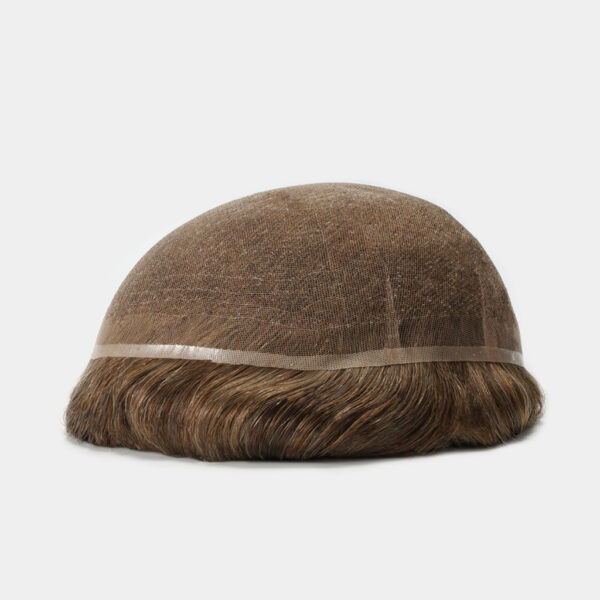
Lace hair systems are known for breathability, softness, and a natural front hairline. French lace is commonly used because it balances comfort and durability, while Swiss lace is usually softer and more delicate.
Lace is a strong choice for clients who exercise often, live in warmer climates, or want a breathable base. A lace front can also help create a more realistic exposed hairline.
Some lace stock systems combine lace with PU on the sides and back, making the unit easier to tape and attach. For example, a lace base with PU sides and back can give salons a useful balance of breathability, natural appearance, and attachment convenience.
Best for:
- hot or humid environments;
- breathable daily wear;
- natural-looking hairlines;
- active clients.
Watch out for:
- more careful cleaning;
- Knots may need bleaching or professional finishing.
- Delicate lace can wear faster than heavier base materials.
There are multiple lace materials. But we usually use French lace and Swiss lace for men’s and women’s hair systems. Although Swiss lace is softer and more delicate, they last considerably longer.
Our HS7 has a full French lace base. It has single split knots along the front hairline and double reverse knots on the rest of the base. This guarantees both a natural and durable hair system.
The HS7 also has bleached knots all over, which makes it look even more natural. Our HS7 is one of our best-selling models because it is natural, undetectable, and breathable, which are often the most important elements when customers are choosing a suitable system. We also recommend this system for those who exercise frequently or live in a humid and hot environment.
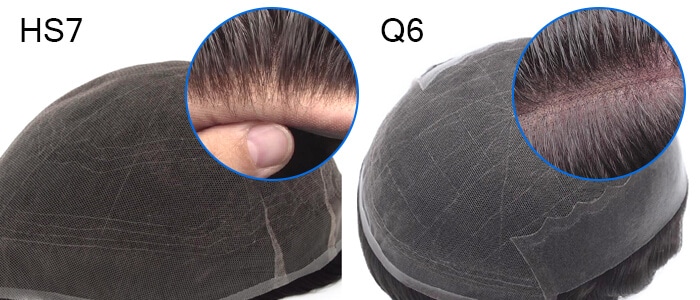
If you would like a skin base with poly in order that you can use tape more easily, you should consider the Q6. Our Q6 model is French lace with clear PU at the back and sides. This makes the system easier to attach and the addition of poly increases the overall durability of the hair system.
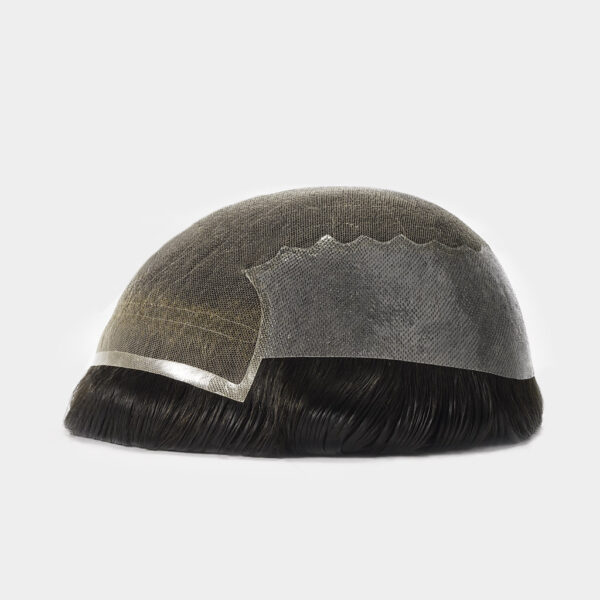
If a client requires a full poly perimeter, we have the Australia and D7-5 models available. However, these two models only come in 1B+# color and medium-density hair.
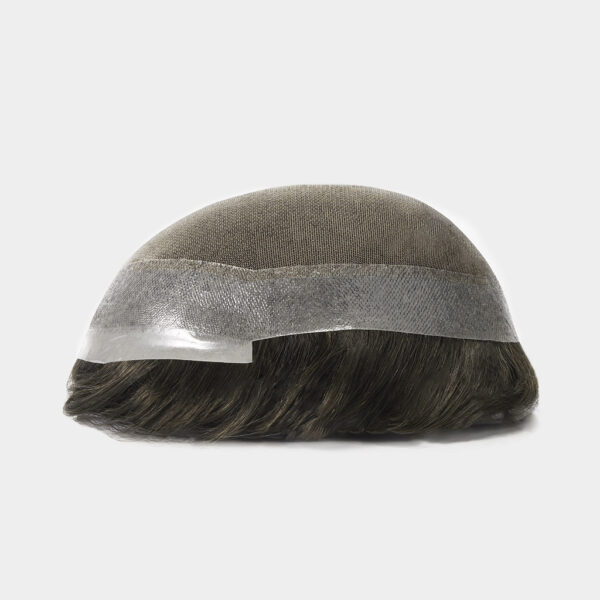
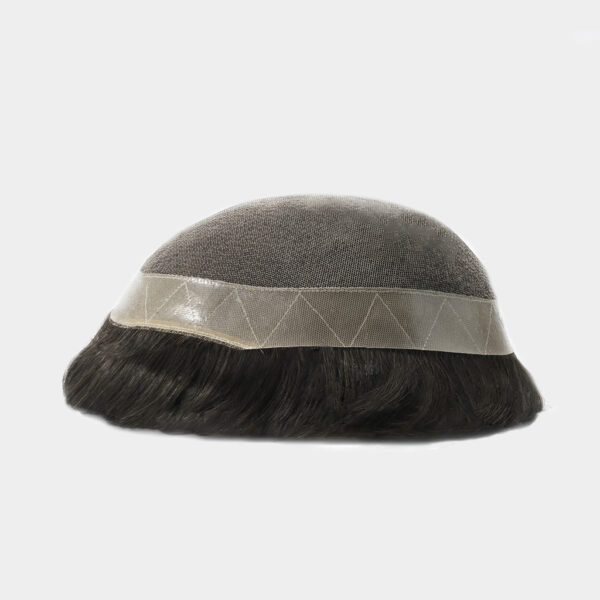
Mono Hair Systems
Mono bases are often chosen when durability matters. Fine mono or welded mono can hold heavier density and may be used in hybrid designs with lace fronts, PU perimeters, or skin sections.
A mono center with a lace front and PU perimeter can give the wearer a stronger base while still keeping the front more natural. This type of design is useful for clients who want longer wear and do not need the thinnest possible base.
Best for:
- durability;
- heavier density;
- clients who need stronger construction;
- longer-term wear.
Watch out for:
- may feel thicker or stiffer than lace or ultra-thin skin;
- may not be as invisible at the hairline unless combined with a lace front;
- Comfort depends heavily on design and fit.
Our HS27+ has fine mono in the center, a cut-away skin gauze perimeter, and a lace front with bleached knots. The HS27+ has a natural hairline and it is more durable than other stock models as it will last between 6 and 12 months.
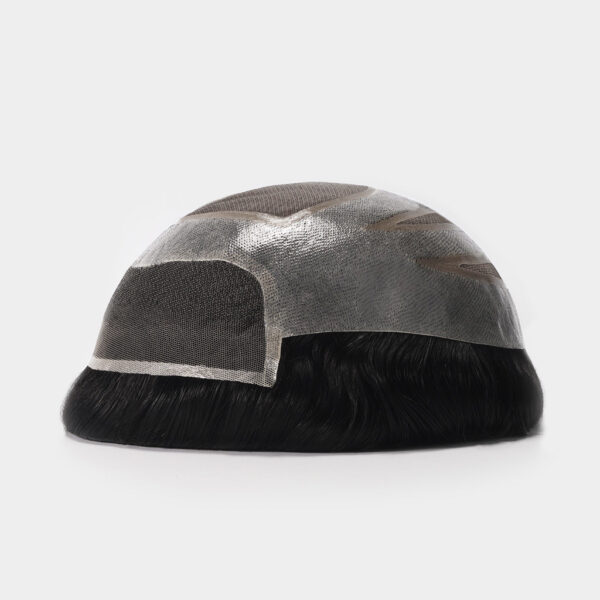
The HS27 is similar to the HS27+, but it does not have a lace front. If a customer wants a durable system but is not overly concerned about a natural hairline, you can choose our HS27 model.
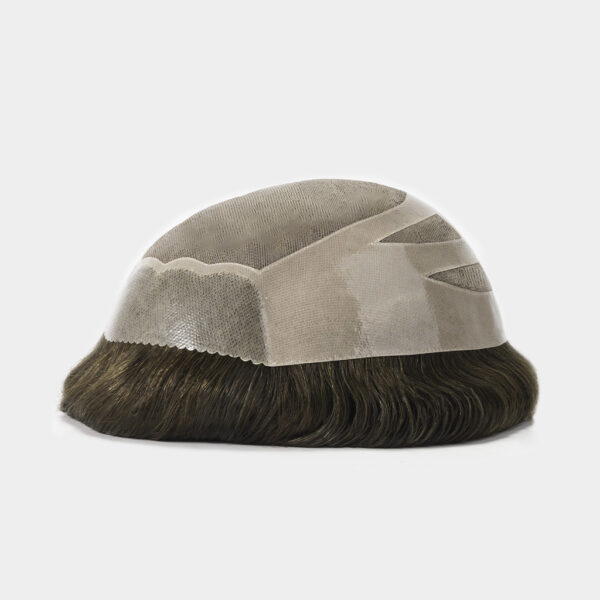
Last but not least, there is fine-welded mono.
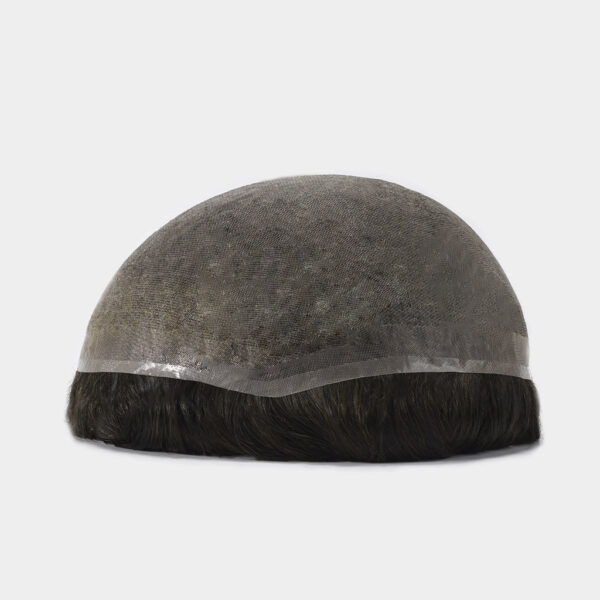
Our NCON model has an all-over fine-welded mono base. The weaves of the base material are large enough to make the piece breathable. It is a little stiffer than French lace, which makes it more durable than lace. We bleach knots around the crown and at the front, so this model is very natural looking.
Different Hair Densities of Stock Hair Systems
We not only have stock systems with different base materials, but you can also choose from a medium-light density or a medium density.
Popular medium-light density stock hair systems include the HS7, HS1, N6, and HS25-V.
Popular medium-density stock hair systems are Australia, the HS27+, D7-3, D7-5, and P1-3-5. Many medium-density stock men’s toupees are new models this year and come in different base sizes: 6”x8”, 6”x9”, 7”x10”, and 8”x10”, and in #1B or #1B+ color. We predominantly sell these models to the Indian and Middle Eastern markets, so we do not offer them in lighter colors.
All our stock hair systems are available for instant delivery and are sent out within 24 hours. They will take just 3-5 days to arrive. If your customers need a hair system urgently, or if you want to check our quality before you make regular orders, we suggest you place a trial stock order. As we mentioned earlier, please contact us for our toupee price list and our latest inventory.
What Is a Custom Hair System?
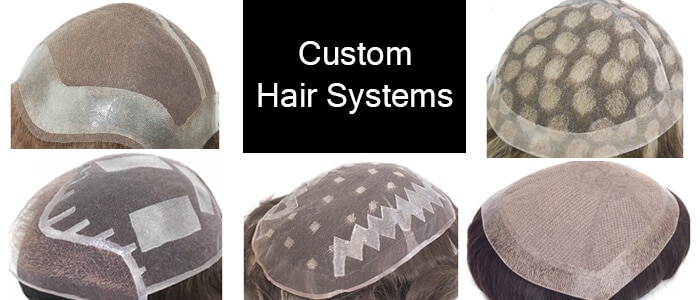
A custom hair system is made according to the client’s specific requirements. Instead of choosing only from available stock specs, the salon can submit detailed instructions for the base, hair, color, density, curl, contour, and finished style.
A custom order may include:
- base size;
- base shape and contour;
- base material combination;
- hair length;
- hair color;
- grey percentage;
- grey distribution;
- hair density;
- curl or wave;
- hair direction;
- crown position;
- ventilation method;
- bleached knots, V-looping, injection, or other knotting methods;
- hairstyle or cut-in requirements.
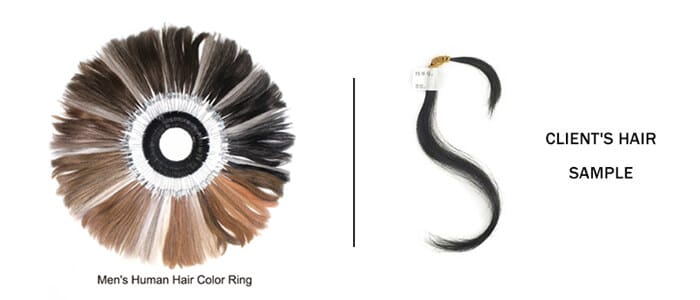
The two most important details are usually base fit and color match. For the best result, salons should send a head template and a physical hair sample when possible. For difficult grey or mixed-color cases, photos alone are not reliable enough.
When Custom Hair Systems Are the Better Choice
Custom is best when the client’s needs are too specific for stock.
1. Difficult Color Matching
If the client’s hair has multiple tones, faded ends, warm undertones, ash tones, highlights, or color variation across the head, custom matching is usually better.
However, the process matters. A custom order based only on phone photos can still fail because lighting, filters, camera settings, and screen differences can distort color.
For difficult color cases, salons should use:
- a physical hair sample;
- a factory color ring;
- clear notes about the target color;
- multiple samples if the client’s hair varies by area;
- a small trial order before scaling.
2. Grey or Salt-and-Pepper Matching
Grey matching is more complicated than choosing a single percentage. A client may have 20% grey overall, but 40% at the temples, 10% on top, and a different blend at the crown.
That is why custom is usually the better choice for grey cases, but only when the salon gives enough detail.
A strong grey-matching brief should include:
- total grey percentage;
- grey distribution by area;
- whether the grey is white, silver, ash, or salt-and-pepper;
- whether grey should be concentrated at the temples, front, crown, or sides;
- a physical sample if possible.
Based on internal VOC analysis, grey matching is not the most common issue, but when it fails, it can become a high-consequence dissatisfaction driver.
3. Special Base Size or Contour
Some clients need a non-standard base because of head shape, scar coverage, previous surgery, unusual thinning pattern, or a very specific hairline position. In these cases, a custom template can improve the fit.
Custom is also useful when the salon needs to control:
- temple shape;
- recession depth;
- crown placement;
- front contour;
- sideburn shape;
- parting area;
- integration with existing hair.
4. Repeat Clients with Proven Specs
Once a salon has confirmed the client’s ideal formula, customization becomes much more powerful. The first order is about learning. The repeat order is about consistency.
For repeat clients, custom can help the salon reproduce the same:
- base design;
- density;
- color blend;
- wave;
- grey distribution;
- hair direction;
- cut-in plan.
This is where custom ordering becomes less risky: the salon is no longer guessing.
Stock vs. Custom Hair Systems: The Real Difference
The biggest difference is not simply “ready-made vs. personalized.” The real difference is speed vs. precision.
Factor | Stock Hair System | Custom Hair System |
Lead time | Faster when available | Usually takes weeks |
First-order risk | Lower for testing supplier quality | Higher if specs are uncertain |
Fit | Standard size, can often be cut down | Built to template or measurements |
Color | Limited to available stock colors | Better for special colors and grey blending |
Density | Available stock densities | More control |
Base designBest use | Fixed model designs | More design flexibility |
Best use | Urgent, standard, first trial | Complex, repeat, highly specific |
Main risk | Not exact enough for special cases | Wrong specs can create costly remake issues |
The Best Ordering Strategy for Salons
The safest professional buying strategy is not “always stock” or “always custom.” It is to use each option at the right stage.
Step 1: Start with stock
Use stock to test quality, delivery, color chart reliability, density, and durability. This is especially useful for new salons, new suppliers, or first-time wholesale buyers.
Step 2: Move to semi-custom
Once the salon knows which base, color, density, and hair type work best, small modifications can be added. This may include base cutting, styling, light design changes, or choosing a stock model as the starting point.
Step 3: Use full custom for repeat or complex clients
Use full custom when the client needs a precise template, difficult grey blend, unusual contour, special density map, or repeatable long-term formula.
This ladder helps reduce refund risk, protects urgent appointments, and gives the salon a more reliable path to scaling orders.
Pre-Order Checklist: What to Confirm Before Buying
Before ordering either stock or custom hair systems, confirm these details:
- Is the unit stock, semi-custom, or full custom?
- What is the real lead time?
- Which warehouse will ship the order?
- Is the base size suitable, or does it need cutting?
- What is the density?
- What is the hair length?
- What is the curl or wave?
- How should the hair direction be styled?
- Is the color confirmed by a color ring or sample?
- Is the gray percentage and grey placement clearly mapped?
- What is the return or exchange policy?
- Has the client agreed to the timeline?
For custom orders, also confirm the template, measurements, ventilation method, crown position, base material, and any special notes before production begins.
Which One Should You Choose?
Choose a stock hair system if you need speed, want to test supplier quality, have a standard client case, or need a practical first order.
Choose a custom hair system if the client needs a precise fit, difficult color match, special grey distribution, unusual density, specific hair direction, or a repeatable long-term design.
For most salons, the best answer is not one or the other. The best answer is sequence:
Stock for speed and learning. Custom for precision and repeatability.
That approach gives you the best chance of protecting client appointments, reducing first-order risk, and building a more reliable hair replacement workflow.