



- Key Takeaways
- Does Insurance Cover Hair Systems? The Real Answer
- Your Medical Wig Can Be Covered, But the Wording Matters
- Wig Coverage vs. Hair Loss Treatment
- How to Get a Cranial Prosthesis Covered by Insurance
- How Much Does a Cranial Prosthesis Cost?
- Medicare Coverage: Does Medicare Cover Wigs for Cancer Patients?
- State Questions: California, Florida, Medicaid, and BCBS
- Medical Wigs Covered by Insurance Near Me
- Newtimes Hair: Practical Help for Salons and Hair Pros
- For Salons: Help the Client Without Becoming the Insurance Agent
- Final Word
- About the Author
- FAQs About Hair Systems and Insurance
Does Insurance Cover Hair Systems and Wigs? Wig Cost and Coverage Explained
- Key Takeaways
- Does Insurance Cover Hair Systems? The Real Answer
- Your Medical Wig Can Be Covered, But the Wording Matters
- Wig Coverage vs. Hair Loss Treatment
- How to Get a Cranial Prosthesis Covered by Insurance
- How Much Does a Cranial Prosthesis Cost?
- Medicare Coverage: Does Medicare Cover Wigs for Cancer Patients?
- State Questions: California, Florida, Medicaid, and BCBS
- Medical Wigs Covered by Insurance Near Me
- Newtimes Hair: Practical Help for Salons and Hair Pros
- For Salons: Help the Client Without Becoming the Insurance Agent
- Final Word
- About the Author
- FAQs About Hair Systems and Insurance

So, does insurance cover hair systems? Sometimes, yes. But there is a catch, because of course there is.
Most insurance plans do not want to pay for anything they see as cosmetic. A regular wig can fall into that bucket fast. But a medical wig, hair prosthesis, or cranial prosthesis may be different when a doctor says it is medically needed.
That one phrase can change the whole conversation.
Key Takeaways
- Insurance may help pay for hair systems when hair loss comes from a medical condition or treatment.
- The words matter. “Cranial prosthesis” usually works better than “wig” on paperwork.
- Cancer treatment, alopecia areata, burns, scalp injuries, and some treatments may improve the chance of coverage.
- Original Medicare usually does not cover wigs for cancer patients, though some Medicare Advantage plans may offer extra benefits.
- Medicaid coverage depends on the state.
- Blue Cross Blue Shield coverage depends on the specific BCBS company and plan.
- A doctor’s prescription, diagnosis letter, receipt, and claim form can make or break the claim.
Does Insurance Cover Hair Systems? The Real Answer
Yes, insurance can cover hair systems in some cases. But it usually has to be connected to medical hair loss.
That means the hair loss is not just regular thinning or age-related baldness. It is tied to something like chemotherapy, radiation, alopecia areata, lupus, burns, scalp trauma, or another diagnosed condition.
GoodRx explains that insurance generally does not cover hair loss treatment because it is often considered cosmetic. But coverage may apply when the hair loss comes from a medical condition or treatment, including alopecia areata, scalp injuries, or cancer therapy.
When insurance may say yes
Insurance is more likely to help when three things line up.
First, there is a real diagnosis. Second, a doctor writes that the piece is medically needed. Third, the item is submitted as a cranial prosthesis or hair prosthesis, not just a fashion wig.
The National Alopecia Areata Foundation says wig costs are usually prepaid first, then submitted to insurance for possible reimbursement. It also makes one thing very clear: there is no guarantee your insurer will pay.
That is not the fun answer. But it is the honest one.
When insurance may say no
Insurance may say no when the hair system is for style, volume, or pattern baldness with no medical diagnosis.
That does not mean the hair loss is not painful. It can be brutal. Anyone who says “it’s just hair” has probably never watched their own hair fall out in the shower.
But insurance companies do not pay based on feelings. They pay based on policy language.
And policy language can be a cold little monster.
Your Medical Wig Can Be Covered, But the Wording Matters
Your medical wig can be covered when the claim is framed correctly.
Here is the simple version: do not lead with the word “wig” if you are asking about reimbursement. Ask about a cranial prosthesis.
NAAF advises patients to use the term “cranial prosthesis” rather than “wig” because a wig may be considered cosmetic.
Medical wig, cranial prosthesis, hair prosthesis
A medical wig may look like a wig. It may feel like a wig. Your client may call it a wig.
But on insurance paperwork, “cranial prosthesis” usually sounds more medical.
That matters because insurance coverage is often less about common sense and more about categories.
A client with cancer-related hair loss may need a wig to get through daily life. A client with alopecia may need one to feel normal at work. But if the paperwork says “beauty wig,” the claim may already be in trouble.
The chance that your insurance may reimburse you
There is a chance that your insurance may reimburse you, especially if the plan recognizes medical hair loss.
NAAF says more companies are reimbursing some wig costs for people with alopecia areata, but the patient usually pays first and files the claim after.
So no, this is not a magic coupon.
It is a claim. Claims need proof.
Wig Coverage vs. Hair Loss Treatment
Wig coverage and hair loss treatment are not the same thing.
A wig or hair replacement system helps cover hair loss. Treatment tries to stop or reverse it.
Insurance may look at those two things very differently.
How to get insurance to pay for hair loss treatment?
To get insurance to pay for hair loss treatment, start with a medical evaluation.
If the hair loss is from alopecia areata, scalp injury, medication side effects, or cancer therapy, coverage may be possible. If it is standard male or female pattern hair loss, many plans treat it as cosmetic.
So the first step is not buying a product.
The first step is documentation.
Cover hair loss without making the claim weaker
If your goal is to cover hair loss with a wig or hairpiece, ask the insurer about a cranial prosthesis.
Not “Do you cover wigs?”
That question may get you a fast no.
Ask: “Does my plan include insurance coverage for a cranial prosthesis prescribed for medical hair loss?”
That is a better question. It sounds boring. Boring is useful here.
Related Post: How to Avoid Visible Hair System Edges?
How to Get a Cranial Prosthesis Covered by Insurance
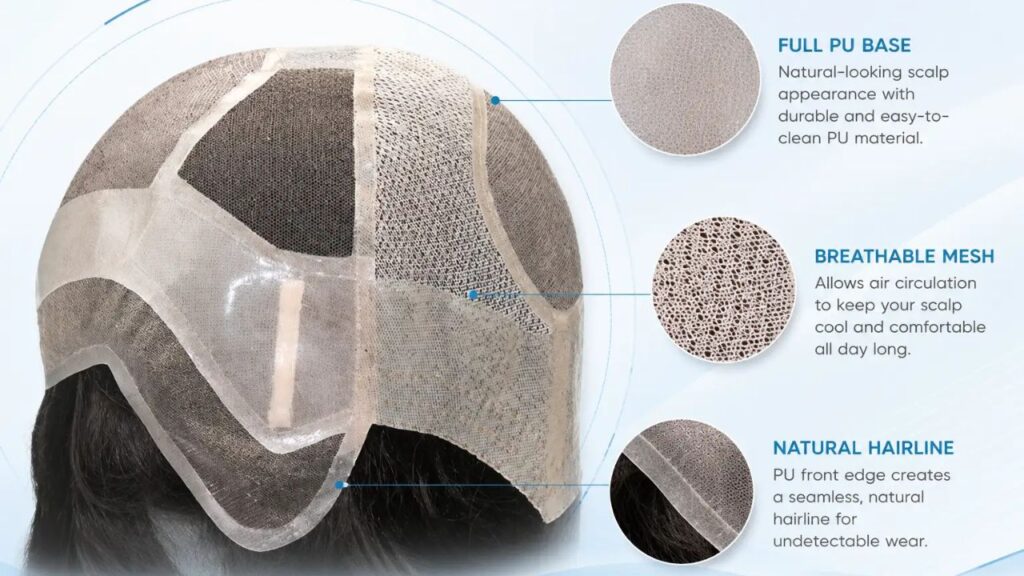
To get a cranial prosthesis covered by insurance, the process usually starts with your doctor.
You need a letter or prescription that confirms the diagnosis and explains why the cranial prosthesis is medically needed. Then you need the receipt, invoice, and claim form from your insurer.
Breastcancer.org notes that some insurance plans cover some or all of the cost of a wig for cancer-related hair loss, but paperwork often has to be filled out correctly to receive reimbursement.
What documents do insurers usually ask for
You usually need:
- A diagnosis letter or prescription from your healthcare provider
- A receipt or invoice for the wig, medical wig, or hair prosthesis
- An insurance claim form
- The right wording, such as “cranial prosthesis.”
- Any required prior authorization
That is the paperwork stack. Not glamorous. Very necessary.
Your insurance may help cover part of the expense
Your insurance may help cover the cost, but it may only cover part of the expense.
Some plans have a dollar cap. Some pay a percentage. Some reimburse once per year. Some deny the whole thing.
This is why clients should call before buying.
Ask before you buy
Ask the insurer: “Do I need prior authorization?”
Then ask: “Is there a yearly maximum?”
Then ask: “Do I need to use an in-network provider?”
Do not hang up until you know what the plan actually wants.
Keep every receipt
Keep the receipt. Keep the invoice. Keep the doctor’s letter (some insurance companies may allow you to keep an online account. Remember to keep your online profile updated).
If the seller can describe the product as a cranial prosthesis or medical hair prosthesis on the invoice, ask for that.
Small detail. Big deal.
How Much Does a Cranial Prosthesis Cost?
The cost of a cranial prosthesis depends on the material, cap design, hair type, length, base comfort, and how custom it is.
Breastcancer.org says wigs can range from under $30 to more than $4,000, depending on the wig and related supplies.
Option | Best For | Typical Price Factor |
Basic synthetic wig | Short-term use or backup wear | Fiber quality and cap comfort |
Human hair wig | Natural look and styling freedom | Hair quality, length, density |
Custom medical wig or hair system | Long-term wear, sensitive scalp, exact fit | Base design, hand-tying, customization |
A cheap wig can solve a short-term problem.
A better wig can solve a daily-life problem.
Those are not the same thing.
Medicare Coverage: Does Medicare Cover Wigs for Cancer Patients?
Here is where things get frustrating.
Original Medicare usually does not cover wigs for cancer patients. GoodRx states that Original Medicare Part A and Part B do not cover the cost of wigs for people undergoing cancer treatment, even when prescribed as a cranial prosthesis.
Medicare.gov lists coverage for prosthetic devices, but wigs are not included in that public list of covered prosthetic devices.
Does Medicare cover wigs for cancer patients?
Original Medicare usually says no.
Some Medicare Advantage plans may offer extra benefits, but those benefits depend on the plan.
So the clean answer is this: Original Medicare usually does not cover wigs. Medicare Advantage might. Check the plan.
Medicare cover rules are not the same everywhere
The phrase Medicare cover gets searched a lot, but people often mix up Original Medicare and Medicare Advantage.
They are not the same.
Original Medicare has one set of rules. Medicare Advantage plans are private plans that may add extra benefits. If a client has Medicare Advantage, they should call their plan directly to ask about Medicare coverage for a cranial prosthesis.
State Questions: California, Florida, Medicaid, and BCBS
State rules are messy.
Plan rules are messier.
Two people in the same state can get different answers because they have different plans.
Does insurance cover hair systems in California?
Maybe.
California had AB 2668, a bill that would have required coverage for cranial prostheses for certain medical hair loss situations. But the official California Legislative Information page says AB 2668 became an inactive bill and died in 2024.
So do not tell California clients, “The law definitely covers it now.”
That is risky advice.
Tell them to check the actual plan.
Does insurance cover hair systems in Florida?
Florida does not have one simple answer either.
Coverage depends on the insurer, the employer plan, Medicaid rules, Medicare Advantage benefits, and the diagnosis.
If the client is in Florida, the best question is still the same: “Does my plan cover a cranial prosthesis for medical hair loss?”
Boring question. Better answer.
Does Medicaid cover wigs for alopecia?
Sometimes, but it depends on the state.
Medicaid.gov explains that states must provide mandatory benefits, while optional benefits vary by state. Prosthetics are listed among optional Medicaid benefits.
That means Medicaid coverage for wigs or hair prostheses can vary a lot.
If a client has Medicaid, they should call the number on the card and ask about a cranial prosthesis for alopecia. Not just a wig.
Does Blue Cross Blue Shield cover wigs for cancer patients?
Sometimes.
But Blue Cross Blue Shield is not one plan. It is a group of separate companies and plan types.
For example, Blue Cross Blue Shield of Vermont has a cranial/scalp/wig prosthesis medical policy that defines a wig or hairpiece as a prosthetic supply for hair loss.
That does not mean every BCBS plan covers every wig.
It means some BCBS plans have policy language for this topic. The client still needs to check their own benefit.
Does BCBS cover cranial prosthesis?
Maybe. It depends on the exact BCBS plan.
Ask for the written policy. Ask about the benefit limit. Ask whether cancer treatment, alopecia, or another diagnosis qualifies.
If the rep says no, ask where that exclusion appears in the plan document.
Nicely. But ask.
Medical Wigs Covered by Insurance Near Me
Searching for medical wigs covered by insurance near me is a good start.
But local does not always mean covered.
A nearby wig shop may know how to write an invoice. A salon may know how to fit and cut the piece. A medical wig provider may understand sensitive scalps. But only the insurance company can confirm coverage.
What conditions qualify for a free wig?
Free wig programs often focus on people with cancer treatment-related hair loss, chemotherapy hair loss, alopecia, or other medical hair loss.
Breastcancer.org suggests checking wig banks and charities if insurance does not pay, and also recommends asking the American Cancer Society or a healthcare team social worker about local resources.
The American Cancer Society also tells patients to ask their cancer care team about local resources for wigs and head coverings.
Free wig programs usually depend on diagnosis, location, income rules, and availability.
So ask early.
Waiting until the hair is already gone makes everything harder.
What insurance companies cover cranial prosthesis?
The better question is not “What insurance companies cover cranial prosthesis?”
The better question is: “Does my exact plan cover it?”
One Aetna plan may be different from another. One BCBS plan may be different from another. One employer may offer richer benefits. Another may not.
Same logo. Different rules.
Yes, it is ridiculous.
No, you are not imagining it.
Newtimes Hair: Practical Help for Salons and Hair Pros
Newtimes Hair is not an insurance company. We do not approve claims.
But we do help salons and hair professionals serve clients who need better hair solutions, including medical wigs, toppers, and hair systems.
Refer to our related article: Common Myths About Hair Systems
Newtimes Hair supplies salons and hair professionals with premium hair systems, wigs, toppers, and extensions, and the company describes its medical wigs as lightweight, soft, and suitable for clients with delicate skin, cancer-related hair loss, or alopecia.
When a wig is better
A full wig can be the better choice when the client has heavy shedding, full-head hair loss, or a sensitive scalp after treatment.
The goal is not just coverage.
The goal is comfort, security, and a natural look under real light.
That means the base matters. The hairline matters. The density matters. The stylist’s cut matters.
A bad wig can make a client feel worse.
A good one can give them their Tuesday morning back.
When a topper or hair replacement system makes more sense
A topper or hair replacement system may work better when the client still has bio hair but needs more coverage on the crown, part line, or front area.
Newtimes Hair supplies salons with stock and custom human hair toppers, wigs, and hairpieces, and also offers custom hair systems for more specific client needs.
This is the part many competitor articles skip.
The insurance claim is only half the problem.
The other half is choosing the right piece, so the client does not end up with something that technically covers the head but feels wrong every second of the day.
For Salons: Help the Client Without Becoming the Insurance Agent
Salons should not promise coverage.
That is how trouble starts.
But salons can help clients prepare better.
A salon can give a clear invoice. It can describe the product accurately. It can explain whether the client is buying a wig, topper, hairpiece, or custom system. It can help the client ask better questions before spending money.
That is useful.
And it keeps everybody out of the “but you said insurance would pay” nightmare.
Final Word
So, does insurance cover hair systems?
Sometimes.
Not always. Not neatly. Not without paperwork.
If the hair system is for general style or ordinary thinning, insurance may treat it as cosmetic. If it is a medical wig, hair prosthesis, or cranial prosthesis for documented medical hair loss, your odds may be better.
Use the right wording. Get the prescription. Keep the receipt. Ask about coverage before buying.
And if you are a salon or hair pro, help your client choose a piece that actually works in real life.
Because the goal is not just to get reimbursed.
The goal is to help someone feel like themselves again.
About the Author

Julia Griffiths is a professional hairstylist, barber, educator, and Newtimes Hair author/reviewer with decades of salon and hair replacement experience. She teaches CPD-accredited men’s hair system courses through Hair Revival Training and shares practical, trustworthy advice based on real salon work. She is also familiar with insurance policies in different countries, including how coverage that could best support her customers in need and claim rules may vary by region.