

Newly Ordered Hair Systems Have Defects, What Can Hair Replacement Centers Do?
How do you send a hair system quality claim if it’s not good enough? Let’s sort this out.
A hair system arrives with a damaged base, unexpected construction details, or specifications that don’t match the confirmed order. What should a Hair Replacement Center (HRC) do next?
Don’t jump straight to a repair, remake, or replacement order. First, establish what happened and collect the necessary evidence. A product problem does not automatically mean a manufacturing defect. It could also result from an incorrect order specification, shipping damage, wear and tear, fitting methods, improper care, or salon processing after delivery.
For HRC owners and clinic managers, a clear claim record makes it easier to explain the problem to a supplier, protect the client’s interests, and avoid unnecessary replacements. It also gives the manufacturer’s quality team something specific to investigate instead of a general complaint that a product is unsatisfactory.
What Counts as a Suspected Hair System Manufacturing Defect?
A suspected manufacturing defect is a product condition or specification discrepancy that may indicate a problem with materials or workmanship. The HRC should compare the delivered unit with the confirmed order and approved references before reaching a conclusion.
Common examples of concerns that may need investigation include:
- **Specification discrepancies:** The delivered product differs from the confirmed order, such as an incorrect base material, size, color, density, or hair length.
- **Base construction problems:** Visible tears, holes, irregular edges, damaged seams, or unexpected structural weaknesses.
- **Hair workmanship concerns:** Hair direction, ventilation, parting, or density distribution differs from the approved instructions and affects the intended appearance.
- **Unexpected damage on arrival:** Problems discovered when opening the package, before the system is fitted or used. These may include creasing, loose threads, unexpected residue, or visible marks.
However, these observations do not establish the cause by themselves. A tear could be related to manufacturing, transit, handling, or subsequent use. A color discrepancy might result from an incorrect specification, an unapproved production variation, or differences between a screen image and a physical reference.
The first task is to document what can be observed. The supplier’s assessment should establish whether the problem is related to manufacturing, shipping, buyer-provided specifications, or subsequent handling.
If the concern is specifically that a replacement unit looks different from an earlier order, use the repeat hair system order checklist. That guide focuses on comparing repeat-order specifications; this guide covers the broader evidence needed to report a suspected quality issue.
What Should an HRC Compare Before Reporting a Manufacturing Defect?
Compare three records: the original specifications submitted by the HRC, the order confirmation approved by the supplier, and the product that was delivered. This helps establish where a discrepancy may have occurred.
| Record | What to check | Why it matters |
| Original request | Requested base material, size, color, density, hair length, and other instructions | Establishes what the buyer originally wanted |
| Supplier-confirmed order | Confirmed model/SKU, selected options, approved measurements, and written changes | Establishes what the supplier agreed to provide |
| Delivered product | Actual construction, measurements, color, density, and visible condition | Shows whether the delivered unit matches the confirmed order |
For example, an HRC may originally request a 7” × 9” base, but the final order confirmation shows 6” × 8”. If the supplier produces the confirmed 6” × 8” size, the difference needs to be reviewed against the original request and subsequent approval rather than automatically classified as a manufacturing defect.
On the other hand, if the confirmed order specifies 7” × 9” and the delivered product does not match, the HRC has a specific discrepancy to raise.
Keep the original order form, emails, approved changes, reference photographs, and confirmation together. Do not rely on memory or an informal conversation when the written order provides a more accurate record. For custom work, retain the approved specifications and pre-production references with the order file.
What Information Should an HRC Document Before Contacting the Supplier?
Before contacting the supplier, assemble one record containing the order information, product condition, timeline, and relevant service history. The following information helps the supplier understand what is being reported and what needs to be investigated.
| Information | What to record |
| Order identification | Original order number, product model/SKU, stock or custom order, and quantity affected |
| Approved requirements | Original order confirmation, custom specifications, approved template or sample, and subsequent written changes |
| Delivery information | Date received, condition on arrival, and date the product was first inspected |
| Problem timeline | When the issue was first noticed, whether it appeared before or after fitting, and how it developed |
| Product condition | Description of the affected area, visible damage, and relevant measurements |
| Service history | Fitting, washing, maintenance, adhesive application and removal, heat exposure, chemical treatment, and other processing |
| Previous actions | Any haircutting, base trimming, cleaning, coloring, repair, or adjustment already performed |
| Supporting evidence | Original photographs, videos, measurements, product labels, and packaging photographs where relevant |
One detail deserves particular attention: record when the problem first appeared. A base that is visibly damaged when a new system is opened presents a different investigation from a similar tear discovered after several months of wear and repeated adhesive removal.
Likewise, if several units from the same order appear affected, identify each unit separately. Do not combine different products and symptoms into one general complaint.
How Should an HRC Photograph a Suspected Hair System Defect?
Photographs should show the actual condition of the hair system, not simply make the problem look more dramatic. A supplier needs to understand where the problem is, how extensive it is, and how it relates to the product’s construction.
For a suspected base or workmanship issue, prepare these photographs:
- Complete top view: show the entire hair system and its overall condition.
- Complete underside: show the base material, construction, and affected area.
- Close-up of the problem: capture the specific tear, irregular edge, damaged seam, or other concern.
- Measurement photograph: where dimensions are relevant, include a ruler or suitable measuring tool in the same frame.
- Product identification: photograph the product label, SKU, and original packaging where available.
- Additional comparison: if the original approved physical reference is relevant, photograph it separately under consistent lighting.
Keep the original image files. Avoid filters, retouching, excessive sharpening, or other editing that changes the appearance of the affected area. Use clear lighting and show enough surrounding material to establish where the damage is located.
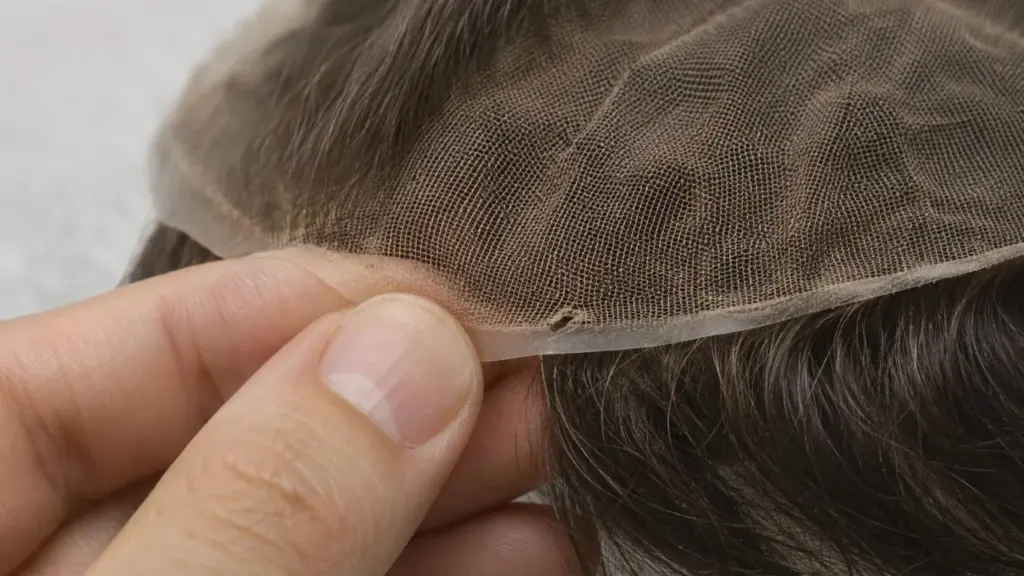
Illustrative close-up of a hand holding the lace edge while a small mesh tear is examined. This is not an actual Newtimes Hair defect record.
When dimensions or the extent of a damaged area matter, include a ruler in the photograph rather than describing the size from memory.
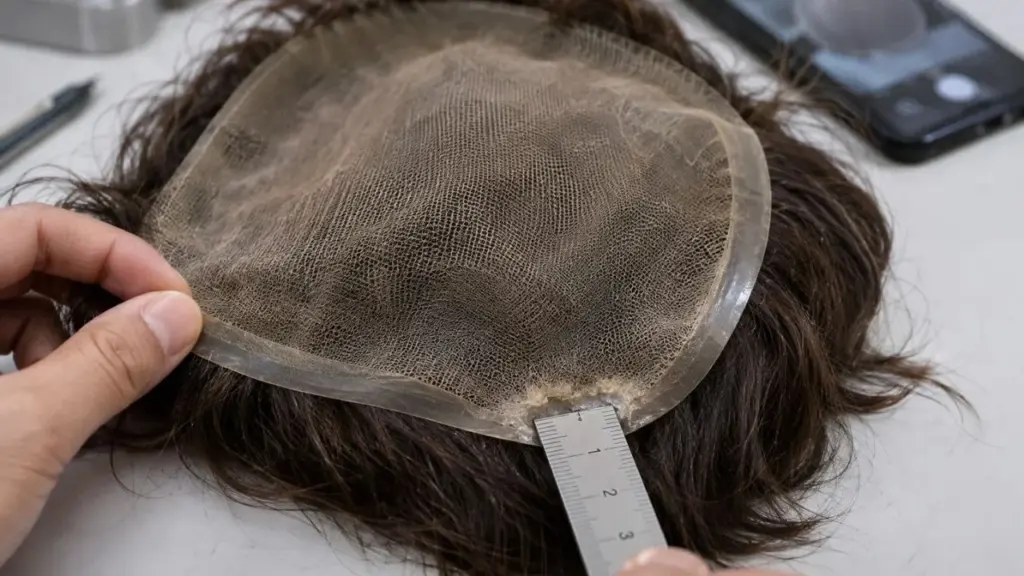
A ruler beside the base helps show the location and approximate dimensions of a reported concern. Illustrative image, not an actual customer claim.
If the shipping carton appears damaged, photograph the unopened outer package, shipping label, visible damage, and internal packaging before discarding anything. After opening the package, photograph the product and packaging together where relevant.
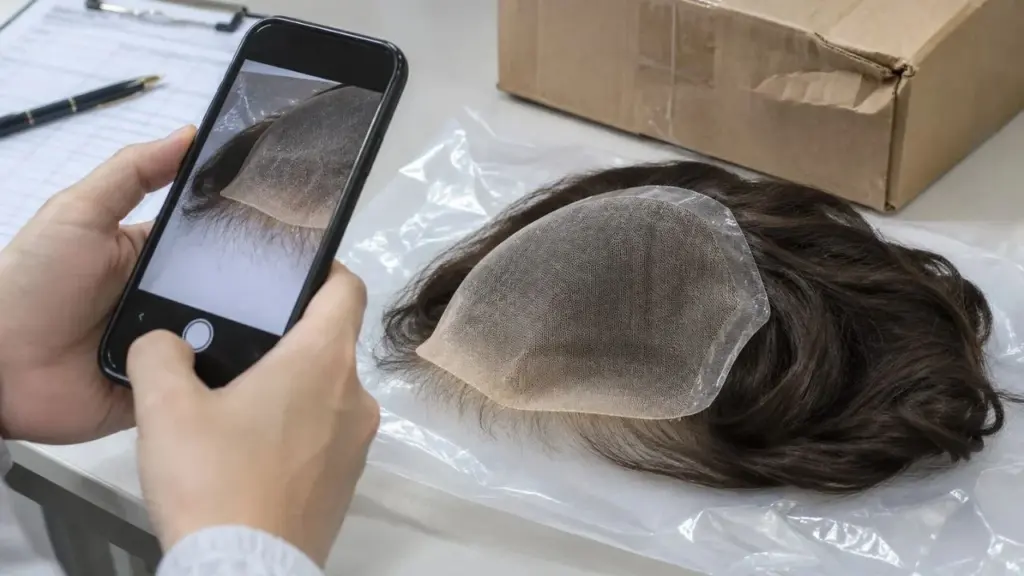
Document the carton, shipping label, internal packaging, and product condition together when transit damage is suspected. Illustrative image.
These images help distinguish possible transit damage from a problem that may have existed before dispatch.
If the product has already been worn or altered, inform the supplier how it was used and what processing was performed. Include relevant photographs, but obtain the client’s permission before sharing identifiable images. If the client’s face is not needed to demonstrate the problem, crop or obscure identifying features without altering the product evidence.
Do not attempt further repairs or alterations before contacting the supplier. Washing, cutting, coloring, bonding, or attempting to repair the affected area may change the condition that needs to be investigated.
For a newly delivered unit with a suspected discrepancy, inspect and photograph it before use. For a unit that has already been worn, document its condition and relevant service history, and avoid further processing until the supplier advises how to proceed, where practicable.
How Can an HRC Distinguish a Manufacturing Issue from a Service or Maintenance Problem?
Compare the product with the confirmed specifications and review the service it has received before deciding whether to request a supplier investigation. Similar symptoms can have different causes.
| What the clinic notices | What should be investigated first |
| Incorrect base size or construction | Compare the delivered product with the original order and approved template |
| Color or density discrepancy | Compare against the original physical color reference and specified density distribution |
| Torn lace or damaged skin base | Document the affected area and when the damage was first noticed |
| Hair shedding or thinning | Distinguish hair coming away from the base from mid-shaft breakage |
| Tangling or dry hair | Review washing, conditioning, brushing, heat exposure, and maintenance history |
| Attachment failure | Review scalp preparation, adhesive or tape selection, application, wear conditions, and removal |
| Different appearance after a repeat order | Compare the new unit with the original approved specifications and references |
Hair Shedding vs. Hair Breakage
HRCs investigating hair loss complaints need to distinguish between hair shedding and hair breakage. Both can make a hair system look thinner, but they have different causes and require different investigations.
Hair shedding occurs when strands come away from the base. Hair breakage occurs when the hair shaft snaps, leaving shorter pieces behind. For more detail, see our hair system shedding and breakage guide.
Dryness, tangling, and other changes that develop over time should also be assessed against the client’s maintenance routine. Our hair system maintenance guide explains the care practices that help maintain the hair and base. For persistent tangling, see what causes tangling on hair systems.
These checks help the HRC provide the supplier with a more accurate description of the problem rather than assuming every visible change is a manufacturing defect.
What Happens After a Supplier Receives a Hair System Quality Claim?
A supplier needs to assess the reported problem against the original order and the actual condition of the product. Depending on the concern, the investigation may involve several checks:
- **Order review:** Confirm the product model, approved specifications, and any documented changes.
- **Evidence review:** Examine photographs, videos, measurements, and the reported timeline.
- **Product inspection:** Check the affected base material, workmanship, ventilation, hair construction, or other relevant areas.
- **Service-history review:** Consider fitting, maintenance, chemical treatment, and other processing where these may have contributed to the problem.
- **Further assessment:** Request additional evidence or physical inspection if the available information is insufficient.
Photographs can show where a problem appears, but they may not establish its cause. Some construction or workmanship concerns require a closer examination of the physical unit.
If the supplier requests the product, obtain the return authorization and shipping instructions before sending it. Keep the original order confirmation, correspondence, photographs, and any case reference together.
After submitting the claim, record any additional information requested and the response received. If the supplier provides a case number or an agreed next step, retain it in the same claim record. This prevents important details from getting lost when the issue is handled by different employees.
The supplier’s assessment should distinguish a confirmed manufacturing issue from buyer-provided specification errors, shipping damage, wear, incorrect application, or subsequent processing.
Repair, Remake, or New Order: Why the Cause Matters
A repair, remake review, and new order solve different problems. They should not be treated as interchangeable options.
- Maintenance or service correction may be appropriate when the problem relates to fitting, handling, or care.
- Repair assessment may be appropriate when the damage is localized, and the unit remains suitable for professional repair.
- Remake review may be necessary when an issue has been confirmed against the original order, and the applicable order terms allow this remedy.
- A new order may be more practical when the existing system is no longer serviceable, has reached the end of its useful life, or the client’s requirements have changed.
The supplier’s findings and the applicable order terms should guide this decision. An HRC should not promise a free remake or refund to its client before the supplier has assessed the evidence and confirmed the applicable resolution.
The aim is not to replace every product that develops a problem. It is to establish what happened and choose a solution that is technically and commercially appropriate.
How Newtimes Hair Supports Product Quality and Repair Concerns
Newtimes Hair’s Custom Hair Systems quality information states that its quality-control program includes 40 checkpoints across a six-stage inspection process. The company’s Quality & Compliance program also describes manual and automated inspection of finished products under an ISO 9001 quality management system.
Newtimes Hair’s published factory inspection walkthrough describes how a finished system is checked against its order form. The walkthrough identifies tools such as color rings, curl and density standard templates, front-contour templates, and the production manual. It also gives examples of checking knots and stitching details against production guidelines. Because this walkthrough was published in 2020, the QC team should confirm that these specific inspection examples still reflect current practice before the page is published.
Newtimes Hair also publishes information about its hair system repair services. Depending on the construction and condition of the unit, possible repair work can include adding hair to thinning areas, repairing damaged lace, skin, or mono base materials, and working on the front lace area.
However, not every damaged hair system is suitable for repair. The condition of the base, remaining hair, ventilation, and affected areas all matter. For more information, see Newtimes Hair’s published hair system repair process.
A repair service and a manufacturing warranty claim are not automatically the same thing. Whether a reported issue qualifies for a particular remedy must be assessed against the actual findings and the terms applicable to the order.
How Can an HRC Submit a Hair System Quality Concern to Newtimes Hair?
HRCs can submit product and order concerns through the Newtimes Hair Feedback & Complaints form or contact their assigned sales representative.
For a more efficient review, prepare the following information:
- Original order number and product model/SKU.
- Stock or custom order type.
- Date the product was received.
- A description of the observed problem and when it first appeared.
- Relevant approved specifications or order confirmation.
- Clear photographs of the affected area and overall unit.
- Shipping and packaging photographs, where applicable.
- Previous fitting, maintenance, and processing history.
The Feedback & Complaints form includes a Related Order Number / Product field and accepts up to three attachments, each no larger than 10 MB. Supported formats are JPG, PNG, and PDF. If the investigation requires video evidence or additional files, contact your assigned sales representative to confirm how to provide them.
Example: What Should a Supplier Claim Message Include?
A clear description is more useful than simply reporting that a product has a quality problem. For example:
| Order Number: [Order Number] |
| Product: [Model / SKU] |
| Date Received: [Date] |
| Issue Observed: The delivered base appears to differ from the confirmed dimensions. |
| When Discovered: During the initial inspection, before fitting or alteration. |
| Evidence: Attached photographs showing the complete base and the affected measurements. |
| Requested Review: Please compare the delivered unit with the confirmed order and advise whether additional information or physical inspection is required. |
The HRC should describe what it observed rather than state that a manufacturing defect has already been confirmed.
If Newtimes Hair requests further information or a physical inspection, follow the team’s instructions before arranging a return. The appropriate next step will be confirmed after the evidence and, where necessary, the physical unit have been reviewed.
For direct assistance, visit Contact Newtimes Hair or email info@newtimeshair.com.
Final Takeaway: Document the Problem Before Choosing the Remedy
A damaged or unexpected hair system does not automatically mean that the manufacturer is responsible. The first step is to establish what was requested, what the supplier confirmed, what arrived, and what happened to the unit after delivery.
For professional Hair Replacement Centers, a clear quality claim includes the original order, approved specifications, a timeline, photographs, packaging evidence where relevant, and the unit’s service history. This gives the supplier a more reliable basis for investigating the problem and helps the HRC keep its client informed without promising a repair, remake, or refund before the findings are established.
For Newtimes Hair orders, submit the concern through the Feedback & Complaints form or contact your assigned sales representative. Keep the unit and supporting records available until the team confirms how to proceed.
About the Author

Alf Hou
Alf Hou is an independent hair replacement specialist and technical consultant with experience in the non-surgical hair replacement industry since 2018. He began his career at Newtimes Hair (Qingdao Newtimes Hair Industries Co., Ltd.) and continues to collaborate with the company on human-hair product testing and technical evaluation. Today, he provides independent professional support to hair replacement centers, wig salons, hair studios, and hair distributors worldwide.