



How Hair Replacement Studios Match Hair Systems to Clients’ Density, Gray Percentage, Lifestyle, Budget, Base Type and Coverage Needs.
Every client has different priorities when choosing hair replacement systems.
Some care most about achieving a natural look. Some work out frequently and are concerned about heat and sweating. Others want something durable and easy to maintain, while some place greater importance on hair quality and the final hairstyle.
For Hair replacement studios, this means that having more products is not necessarily better. A more practical approach is to cover the most typical client needs first rather than stocking every option across all types of hair systems. The final match can then be fine-tuned based on density, color, gray percentage, base type, and custom hair systems when standard stock does not fit.
In NEWTIMES HAIR’s product selection materials for hair replacement businesses, the key specifications typically reviewed include base size, hair color, gray percentage, density, curl/wave, front contour, base type, and custom needs.
For businesses that offer men’s hair systems, the same selection framework applies.
1. When a Client Wants a Natural Look, Start With Hair System Density, Color, and Gray Percentage
Most clients will not walk in and say, “I want 80% density.”
They are much more likely to say:
“Not too thick.”
“I want it to look more natural.”
“I’d rather people not be able to tell I’m wearing one.”
In these situations, rather than focusing on the client’s age alone, it is more important to look at the density, color, and amount of gray in their existing hair.
NEWTIMES HAIR’s current hair system density references include:
- 80%: Lighter, softer, and more natural-looking
- 100%: A common natural-looking stock density
- 120%: Fuller, with more coverage
- 140%+: Better suited for situations where additional customization needs should be confirmed
- For clients who prefer a lighter result, low-density hair systems can be especially useful when the density is matched carefully to the surrounding hair.
The same principle applies when selecting gray hair systems. Current reference percentages include 5%, 10%, 20%, 30%, 40%, 50%, 65%, and 80%, which can be matched to the client’s natural hair along the sides and temples.
For hair replacement studios, the idea is simple:
Instead of asking, “What should someone this age wear?” ask, “What density and gray percentage look most like this client’s own hair?”
That usually produces a more natural-looking result.
2. A Client’s Lifestyle Directly Affects Base Selection
During a consultation, instead of starting with a long explanation of different materials and technical terms, it is often more useful to first ask the client:
“What matters most to you: a natural look, breathability, easy maintenance, or durability?”
NEWTIMES HAIR currently positions its main hair system base types very clearly:
| Client’s Top Priority | Base to Consider First |
| Natural and undetectable | Skin |
| Breathable, soft, and comfortable | Lace |
| Easy to maintain and well-balanced | Hybrid |
| Stable and durable | Mono |
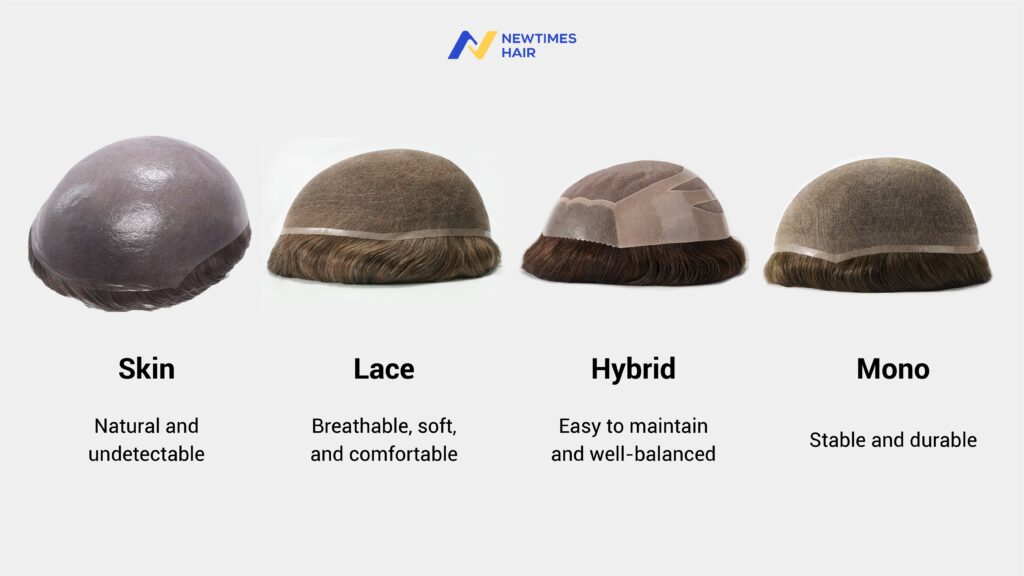
skin hair systems place greater emphasis on a clean hairline and scalp-like appearance. lace hair systems focus more on airflow, comfort, and natural movement. A hybrid hair system offers a better balance among natural appearance, comfort, durability, and maintenance, while mono hair systems place greater emphasis on structure, stability, and longer-term everyday wear.
For example, a lace hair system is worth considering for a client who works out frequently, sweats easily, or lives in a hot climate.
NEWTIMES HAIR’s Lace collection is specifically positioned for warmer climates, active lifestyles, and a lighter wearing experience.
If the client is more concerned about:
“Will it be a hassle to come back to the studio for maintenance later?”
A hybrid hair system can be a very practical option. A Lace + PU construction such as REGAL, for example, uses the PU areas to make attachment and cleaning easier.
In other words, when choosing a base, the first question should not be, “Which base is the best?” It should be, “What does this particular client need most?”
3. Different Budgets Do Not Mean You Need an Extremely Broad Inventory
It is completely normal for clients to have different budgets.
However, even when sourcing wholesale hair systems, an HRC does not necessarily need to carry a complete product range for low-, mid-, and high-price tiers.
A simpler product structure can be:
Core Everyday Options -> Value Options -> Premium Upgrade
Core inventory can handle the needs of most everyday clients.
When comparing stock hair systems vs. custom hair systems, stock units can cover common specifications, while custom options can fill gaps when a client needs something more specific.
For clients who are more price-conscious, selected Limited Stock/Clearance products can be considered. However, NEWTIMES HAIR’s materials also note that availability of colors and sizes in these categories can change quickly, so they are better used as supplemental options rather than as core inventory.
If a client is willing to spend more for higher-end hair quality and a more premium result, they can upgrade to a Remy hair system with a skin or lace base, or a European hair system with a skin or lace base.
NEWTIMES HAIR currently places products such as PANE REMY, AERO REMY, TORQ LUX, and AERO LUX in its Premium & Specialty category, positioning them as upgrade options beyond standard human-hair products.
The benefit of this approach is simple:
A hair replacement center does not need to carry excessive inventory while still being able to serve clients across different budget levels.
4. When a Client Says, “I Want This Hairstyle,” Break the “Look” Down Into Specifications
When a client comes into the studio holding a photo, they usually will not talk about base, density, or front contour.
They will simply say:
“I want this kind of look.”
At that point, what the professional really needs to determine is:
Density + Color/Gray Percentage + Curl/Wave + Front Contour + Base Type + Coverage
These are also the key items highlighted in NEWTIMES HAIR’s product selection checklist.
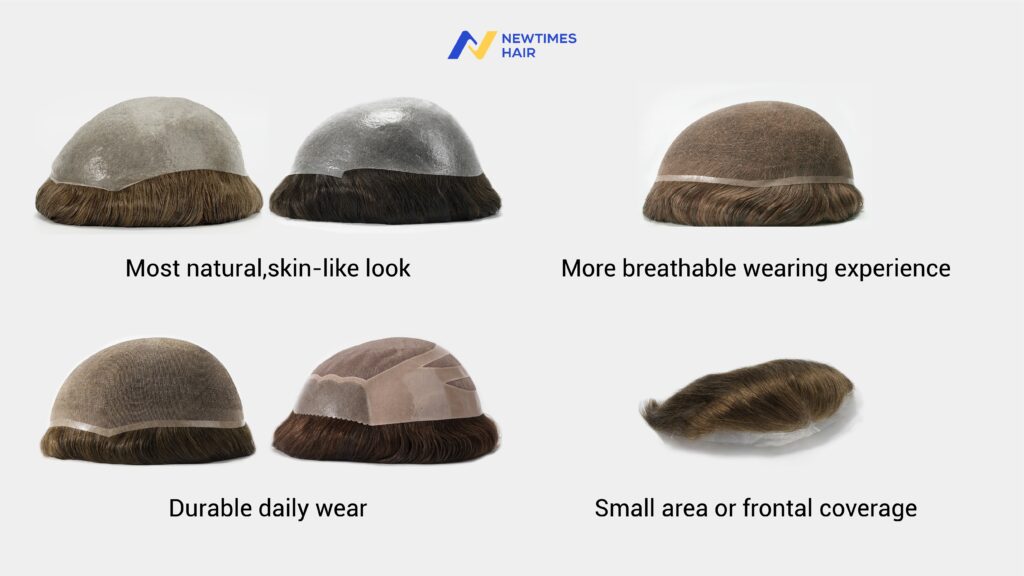
For example, the current Style Reference provides very straightforward guidance:
- Most natural, skin-like look -> Ultra-thin skin / V-looped skin
- More breathable wearing experience -> Lace base
- Durable daily wear -> Mono / hybrid base
- Small area or frontal coverage -> Frontal
If the client only has hair loss around the front hairline or on the top of the head, a full-size hair replacement system may not be necessary.
For example:
STRYKE FRONTAL is a frontal hair system designed for localized frontal coverage.
STRYKE MINI is a partial hair system better suited for the top of the head or smaller areas requiring partial coverage.
These frontal and partial hair pieces can address localized coverage needs without moving directly to a full-size hair replacement system.
So sometimes, solving the client’s problem is not about “upgrading to a more premium product.” It is about finding the right specifications and the right type of coverage.
A Simpler HRC Product Selection Approach
The product selection logic can be summarized as follows:
| Client Need | What to Prioritize |
| Wants a natural, undetectable look | Density + Skin / Lace + Custom / Hybrid |
| Already has gray hair | Color + Gray % |
| Exercises frequently or is sensitive to heat | Lace |
| Wants easier maintenance | PU |
| Prioritizes durability | Mono |
| Wants more premium hair quality | Remy / European Hair |
| Has localized hair loss | Frontal |
| Needs a special size, color, or hair direction | Custom / Hybrid |
In the end, you do not need to stock everything.
NEWTIMES HAIR currently supports custom hair systems with options including base size, density, hair color, gray percentage, hair direction, base design, and Remy / European hair upgrades.
So a simpler approach to building your product range is:
Use core inventory to cover common needs, and use a custom hair system when a client has special requirements.
This way, clients are not overwhelmed by a huge number of difficult-to-choose products, and hair replacement centers do not have to tie up too much inventory in SKUs that only serve a small number of clients.
Ultimately, the goal is very simple: a client sits down and tells you what they want, and you already have an option on hand that is a good enough match for their needs.
Build a Smarter Hair System Range
Give your clients more ways to find the right match—without stocking every possible option.
From everyday stock systems to custom density, color, gray percentage, base design, and hair direction, the NEWTIMES HAIR team can help you build a more flexible product range around the clients you actually serve.
Ready to find the right options for your business? Leave your contact details below, and your dedicated NEWTIMES HAIR representative will provide personalized support based on your needs.