


- Key Takeaways
- What Makes a Hair System Hairline Look Natural?
- 1. Start With the Right Base Material
- 2. Match the Front Contour to the Client
- 3. Use Front Density to Create a Softer Transition
- 4. Choose Ventilation for the Hairline, Base, and Hairstyle
- 5. Bleached Knots: When They Help and When They Do Not
- Dye-After Treatment: An Alternative to Bleaching Knots
- 6. Make Hair Direction Support the Intended Style
- 7. Use Underhair or Scallops Only When the Base Calls for Them
- What Makes a Hair System Hairline Look Unnatural?
- How NEWTIMES HAIR Approaches a Natural Front Hairline
- Final Thoughts
- FAQs
How to Create a Natural Front Hairline for a Hair System?
- Key Takeaways
- What Makes a Hair System Hairline Look Natural?
- 1. Start With the Right Base Material
- 2. Match the Front Contour to the Client
- 3. Use Front Density to Create a Softer Transition
- 4. Choose Ventilation for the Hairline, Base, and Hairstyle
- 5. Bleached Knots: When They Help and When They Do Not
- Dye-After Treatment: An Alternative to Bleaching Knots
- 6. Make Hair Direction Support the Intended Style
- 7. Use Underhair or Scallops Only When the Base Calls for Them
- What Makes a Hair System Hairline Look Unnatural?
- How NEWTIMES HAIR Approaches a Natural Front Hairline
- Final Thoughts
- FAQs
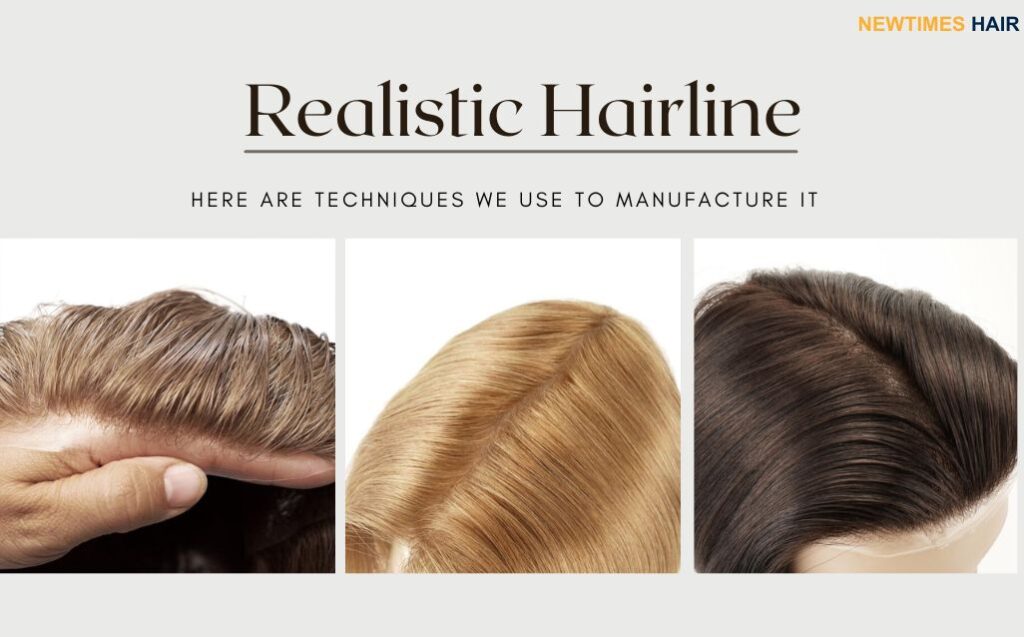
The most natural hair-system hairline is created by matching the front base, contour, density, ventilation method, and hair direction to the wearer’s natural hairline and intended hairstyle. No single feature—such as lace, thin skin, V-loops, or bleached knots—makes every hairline look natural. For salons and hair-replacement professionals, the goal is to balance realism, breathability, attachment, maintenance, and service life.
If the concern is an already-installed system with visible edges, shine, or placement problems, see our separate guide on how to avoid visible hair system edges. This article focuses on the design and construction choices that make the front look natural before and during fitting.
Key Takeaways
- The best professional result balances realism with durability, styling freedom, attachment, and the client’s real maintenance habits.
- Natural hairlines depend on the complete front design, not one feature in isolation.
- Fine lace and thin skin can both create realistic exposed hairlines, but they use different ventilation and maintenance approaches.
- A softer front contour and graduated density usually look more believable than a very straight, uniformly dense edge.
- V-loop ventilation gives thin skin a knotless appearance; single split knots are a strong choice for natural-looking lace fronts and selected skin bases.
What Makes a Hair System Hairline Look Natural?
The front hairline is where small design decisions become most visible. A base that is technically excellent can still look artificial if the contour is too straight, the density is too heavy, or the knots are too obvious. The opposite is also true: a delicate front can look very natural and work for the wearer, even if the rest of the system uses stronger materials.
| Design Factor | Why It Matters | Professional Goal |
| Front base | How visible the edge and scalp transition are | Lace, thin skin, or a hybrid front chosen for the client’s style and maintenance |
| Front contour | Whether the shape suits the client’s face and recession pattern | A shape that looks believable rather than overly straight or overly low |
| Front density | How abruptly the hair begins at the edge | A softer, graduated transition when appropriate |
| Ventilation | Hair direction, lift, knot visibility, and security | V-loop, single split knots, or another method matched to the base and style |
| Knot / root visibility | Whether dark attachment points show through the base | Bleached knots on suitable lace, knotless ventilation on skin, or another compatible construction |
| Hair direction | How naturally the front lifts, lies, or brushes back | Ventilation and direction that support the intended hairstyle |
| Edge finishing | Whether the front edge looks too straight or bulky | Clean finishing, suitable contouring, and optional specialty details where appropriate |

1. Start With the Right Base Material
The front part of the base determines how the hairline can be ventilated, attached, maintained, and viewed under close inspection. Choose the front construction before deciding on density or knot treatment.
Guide to popular hair-system base designs
Use the client’s hairstyle, density needs, maintenance routine, and priorities to choose the front construction.
For an Exposed or Brushed-Back Hairstyle
When the front will remain visible, a fine lace hair system is often a strong option because it provides airflow and can create a discreet transition at the front. The final result still depends on the lace type, knot method, density, contour, attachment, and fitting.
For a Knotless-Looking Front
A thin-skin hair system with V-loop ventilation can create a smooth, knotless-looking root. This may suit clients who want a close-to-scalp appearance, but very thin skin and knotless ventilation require gentler handling and realistic expectations about durability and maintenance.
When Realism and Durability Conflict
A hybrid hair system can use different materials in different zones. For example, a more discreet material may be used at the front while mono or PU provides additional structure or a practical attachment area elsewhere. This is useful when one client needs both front realism and stronger support.
For Higher Density Requirements
A monofilament hair system may be appropriate when density, knot security, and service life matter more than achieving the least visible possible base. Mono can support higher density, but its mesh may be more visible than lace or thin skin.
The practical question is not which construction is universally best. It is which construction gives this client the right balance of realism, comfort, attachment, maintenance, and service life.
| Client priority | Construction to consider | Main consideration |
| Breathable exposed front | Fine lace | Breathable and discreet, but needs careful handling |
| Knotless-looking front | Thin skin with V-loop ventilation | Very natural root, but durability may be lower |
| Different needs across the base | Hybrid construction | Balances realism, attachment, and durability |
| Higher density or durability | Mono or reinforced construction | Supports density and wear, but may be more visible |

2. Match the Front Contour to the Client
Front contours (including Standard, A, AA, B, BB, C, and CC) should be based on the client’s actual hairline, facial proportions, hairstyle, and desired result. A client template is usually more reliable than selecting a contour letter alone.
When selecting a contour, consider:
- the client’s existing recession pattern and temple shape;
- forehead proportions and face shape;
- age and the density of the remaining side and back hair;
- whether the hairstyle exposes or covers the front;
- whether a stock contour is close enough or a custom template is needed.
A hairline can look artificial when it is too low, too straight, too sharp, or simply inconsistent with the rest of the client’s hair. For custom work, a well-made template gives the factory a much better reference than choosing a contour letter without considering the client’s actual shape.
Contour labels are useful reference points, but they should not be treated as fixed gender rules.
3. Use Front Density to Create a Softer Transition
Real hairlines rarely begin as a uniform wall of hair. When the client and base design allow it, a graduated front density can create a softer transition from the first rows into the main body of the system. This reduces the “plugged-in” or helmet-like look that can appear when the front is too full and too even.
Density should still be chosen for the whole client, not just for the front. NEWTIMES HAIR’s low-density hair system guide explains why side-hair density, age, base type, ventilation, hair direction, color, grey percentage, and the final cut all influence whether a lighter system looks natural.
A natural front usually transitions gradually into the main body of the system and, where relevant, into the client’s existing hair.
Professional rule: do not choose the fullest density the base can support. Choose the density that blends with the client and supports the intended style.
4. Choose Ventilation for the Hairline, Base, and Hairstyle
Ventilation is the process of attaching hair to the completed base. NEWTIMES HAIR’s current hair ventilation guide shows why ventilation affects root lift, hair direction, knot visibility, shedding resistance, and styling freedom. Two systems with the same base size, color, and density can perform differently if the ventilation method changes.
| Ventilation | Best Use | Natural-Hairline Benefit | Main Tradeoff |
| V-loop | Ultra-thin skin and knotless-looking hairlines | No traditional knot; natural lift and flexible direction | More delicate than knotted methods; suited to skin bases |
| Single split knot | Lace fronts and selected suitable skin bases | Small knot with natural lift and better security than flat knots | Needs careful direction control; bleaching must be controlled |
| Single flat knot | Targeted areas that need flatter hair direction | Small and discreet with low lift | Less secure than stronger knots; not the default answer for every exposed front |
| Double split knot | Top, crown, back, mono and lace body areas | Stronger hold and controlled direction | Larger and easier to see; usually avoided at a highly exposed front |
V-loop and lace ventilation should not be presented as competing “best” methods. V-loop creates a knotless-looking effect on suitable skin bases, while lace provides breathability and supports traditional lace-front knotting methods.
V-Loop Ventilation: A Knotless-Looking Front on Thin Skin
V-loop does not use a traditional knot. The hair passes through the skin in a V-shaped path, creating a clean root appearance that can mimic hair growing directly from the scalp. At NEWTIMES HAIR, V-loop is used on skin systems, including ultra-thin options such as 0.03 mm and 0.06 mm constructions. It is an excellent realism choice when the client understands that very thin, knotless systems require gentle maintenance.
Single Split Knots: A Lace-Front Option for Lower Knot Visibility
Single split knots are small but create more lift than flat knots. They are commonly used on lace fronts, single-layer lace, and selected skin bases where the hairline needs to look natural without giving up as much security as a flatter, more delicate knot. Because the knot is small, it can also be a suitable candidate for controlled knot bleaching on compatible lace.
Do not automatically use the smallest or most invisible ventilation method everywhere. The front may need realism, while the crown or back may need stronger hold. Combining ventilation methods by zone is often better design than forcing one method across the entire system.
5. Bleached Knots: When They Help and When They Do Not
Bleached knots reduce the contrast of dark knots against the scalp where hair is tied into a hair-system base. They can make an exposed front hairline or parting look more natural, but they are not suitable for every construction, color, or client priority.
Consider bleached knots when:
- The hairline or parting will remain visible.
- The client prioritises a highly natural-looking front.
- The base and knot method support bleaching.
- Dark knots are noticeable against the scalp or lace.
Unbleached knots may be preferable when:
- Durability is more important than maximum knot camouflage.
- The knots are already difficult to see.
- The knotted area is not exposed.
- The hair color or base type is unsuitable for bleaching.
Knot bleaching is a realism-versus-strength decision, not a free upgrade. Over-bleaching can weaken the hair root and increase shedding. Traditional knot bleaching applies only to knots that can be bleached. V-looped and injected skin areas do not have traditional knots to bleach.
| Construction | Traditional knots to bleach? | Practical guidance |
| Knotted lace | Often suitable | Confirm colour, knot type, and treatment area |
| Knotted mono | Sometimes suitable | Confirm the specific model |
| Knotted skin areas | Model-dependent | Confirm the construction |
| V-loop skin | No | The effect comes from knotless ventilation |
| Injected skin | No | There are no traditional knots to bleach |
Dye-After Treatment: An Alternative to Bleaching Knots
Dye-after treatment is another way to reduce the contrast of a dark front hairline on selected lace systems. The front section is initially ventilated with lighter natural hair and then dyed to the required darker shade while the roots remain lighter. This can create a softer transition without chemically lightening the root area.
Dye-after is most relevant to selected French-lace or Swiss-lace constructions and darker colors. It does not apply to V-looped or injected skin areas because those methods do not use traditional knots.
Dye-after should be confirmed for the specific product, color, base, treatment area, and production process. It is a specialised specification, not an automatic option for every custom unit.
If production confirms the D7-3-DYF details, add this final sentence:
NEWTIMES HAIR’s D7-3-DYF is an example of a Swiss-lace front specified for this type of treatment.
6. Make Hair Direction Support the Intended Style
The hairline must support the way the client actually wears the hair. A brushed-back style needs enough lift and forward direction at the front, while a flatter style may require lower lift and tighter control.
Ventilation, hair direction, curl, density, and the final haircut should work together. A system can look convincing in a product photo but look wrong after fitting if the construction does not support the client’s chosen hairstyle.
Before ordering, professional buyers should specify:
- whether the front will be exposed;
- whether the hair will be brushed back, forward, or to the side;
- how much root lift is desired;
- whether the client prefers a softer or more controlled front.
7. Use Underhair or Scallops Only When the Base Calls for Them
Edge treatments should be selected for the specific base rather than added simply because they sound more natural.
Underhair is a specialty edge-finishing option rather than a universal natural-hairline feature. NEWTIMES HAIR’s custom order specifications allow underhair to be requested in selected areas. On some thicker or more visible perimeter constructions, a small amount of underhair can help visually soften the edge. On a very fine front, adding extra hair underneath can work against the goal by introducing unnecessary bulk.
A scalloped front uses small curves to break up the appearance of a straight front edge. It can be useful on suitable constructions, but NEWTIMES HAIR does not recommend scalloping extra-thin skin or lace fronts because the cutting can weaken the front edge or encourage fraying.
What Makes a Hair System Hairline Look Unnatural?
Most unnatural-looking hairlines result from several design choices being mismatched rather than from one isolated defect. Before ordering or fitting, professionals should screen for the following problems:
| Design Problem | Why It Shows | Better Direction |
| Front density is too heavy | The hair begins too abruptly and does not match the client’s remaining hair | Use a softer front distribution when appropriate and match overall density to the client |
| Contour is too straight or too low | The hairline looks drawn on rather than grown in | Choose a stock contour that fits the face or use a custom template |
| Large knots are used at an exposed front | Dark attachment points can become visible when the hair is lifted | Use a smaller front knot or a compatible knotless method |
| The base and ventilation are mismatched | The front may be too bulky, too delicate, or unable to support the desired density/style | Choose the base and ventilation together, not separately |
| Hair direction fights the hairstyle | The front looks stiff or requires constant force to hold the style | Specify root lift and direction for the intended cut and finish |
| A finishing detail is added to the wrong base | Scallops, underhair, or other details can weaken or bulk up a fine edge | Use specialty finishing only where the construction benefits from it |
These problems often interact. For example, a dense front combined with the wrong hair direction can look more artificial than either issue would on its own.
After the system is installed, other factors such as front placement, adhesive shine, lifting, trimming, and styling can also expose the edge. Those fitting issues are covered in our visible hair system edges guide.
How NEWTIMES HAIR Approaches a Natural Front Hairline
NEWTIMES HAIR approaches natural hairline design as a construction decision rather than a single-feature claim. Lace, thin skin, hybrid, and monofilament systems each solve different client requirements.
Lace is generally suited to clients who value breathability and a realistic exposed front. Thin skin can provide a close-to-scalp, knotless-looking effect. Hybrid construction is useful when the front needs a different material from the perimeter or crown. Monofilament construction can be considered when durability and higher density are more important than achieving the least visible base possible.
NEWTIMES HAIR supplies stock and custom hair systems for professional salons, hair-replacement studios, barbers, and distributors.
For clients whose requirements do not fit a stock configuration, NEWTIMES HAIR offers custom hair system options that allow professional buyers to specify base construction, size, front contour, density, hair direction, color, grey percentage, and other design details.
Final Thoughts
A natural hair-system hairline is created through several coordinated choices: front base, contour, density, ventilation, knot treatment, hair direction, and edge finishing. The right combination depends on the client and the intended hairstyle.
For professionals, the best approach is to specify the desired hairline first, then select the base and ventilation method that supports it.
Need help choosing or customizing a natural-hairline design for your salon clients? Contact NEWTIMES HAIR for product and custom-order support.
FAQs
An Engaging Blog Post
September 18, 2026 12:40 pmThank you! Hope this has been of some help
September 24, 2026 11:58 am